The world of Red Horizon
The agency, the ships, the robots and the three centuries of weather, explained in one place. Everything here appears in the films; nothing here is needed to enjoy them.
HELIX
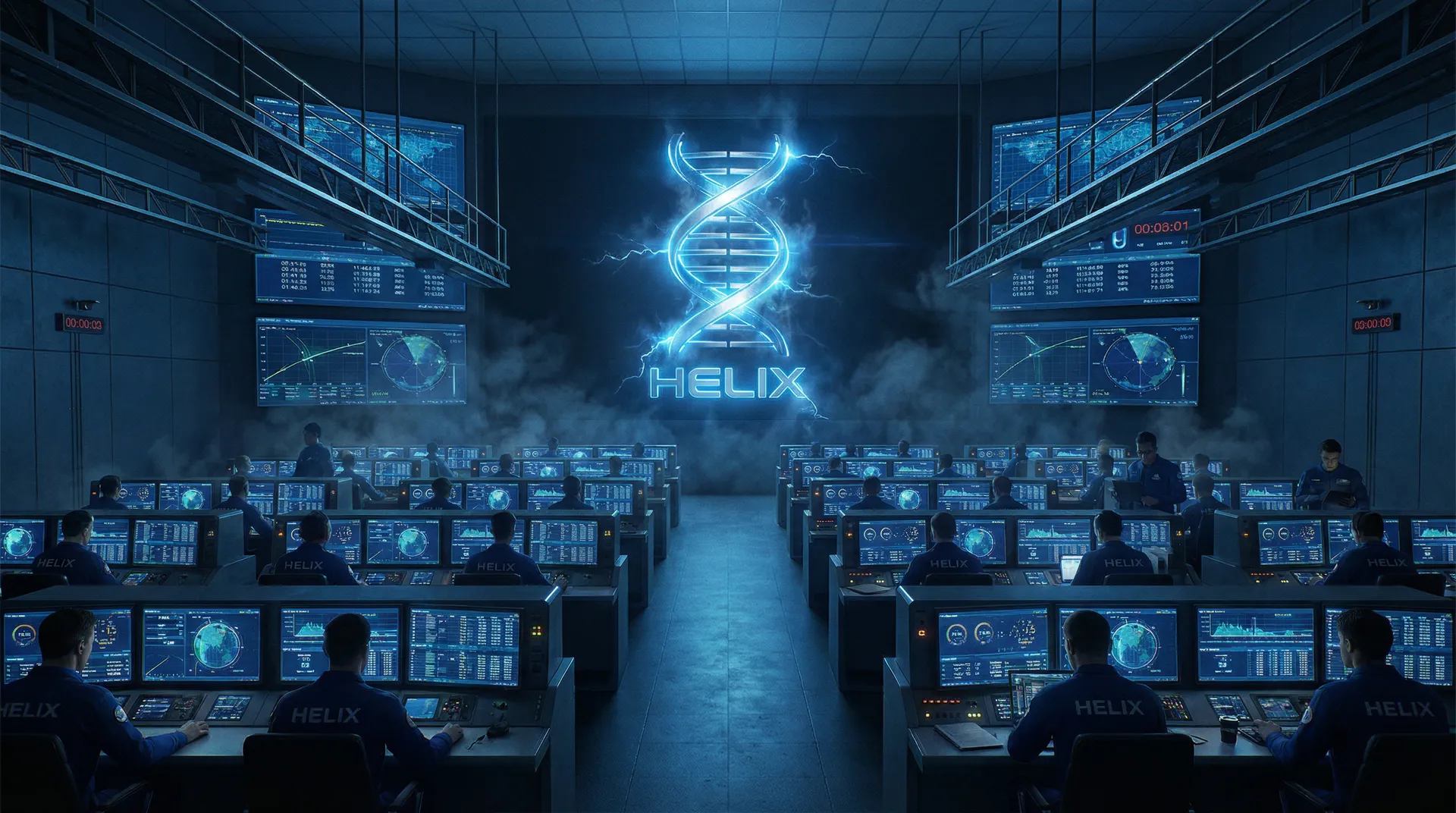
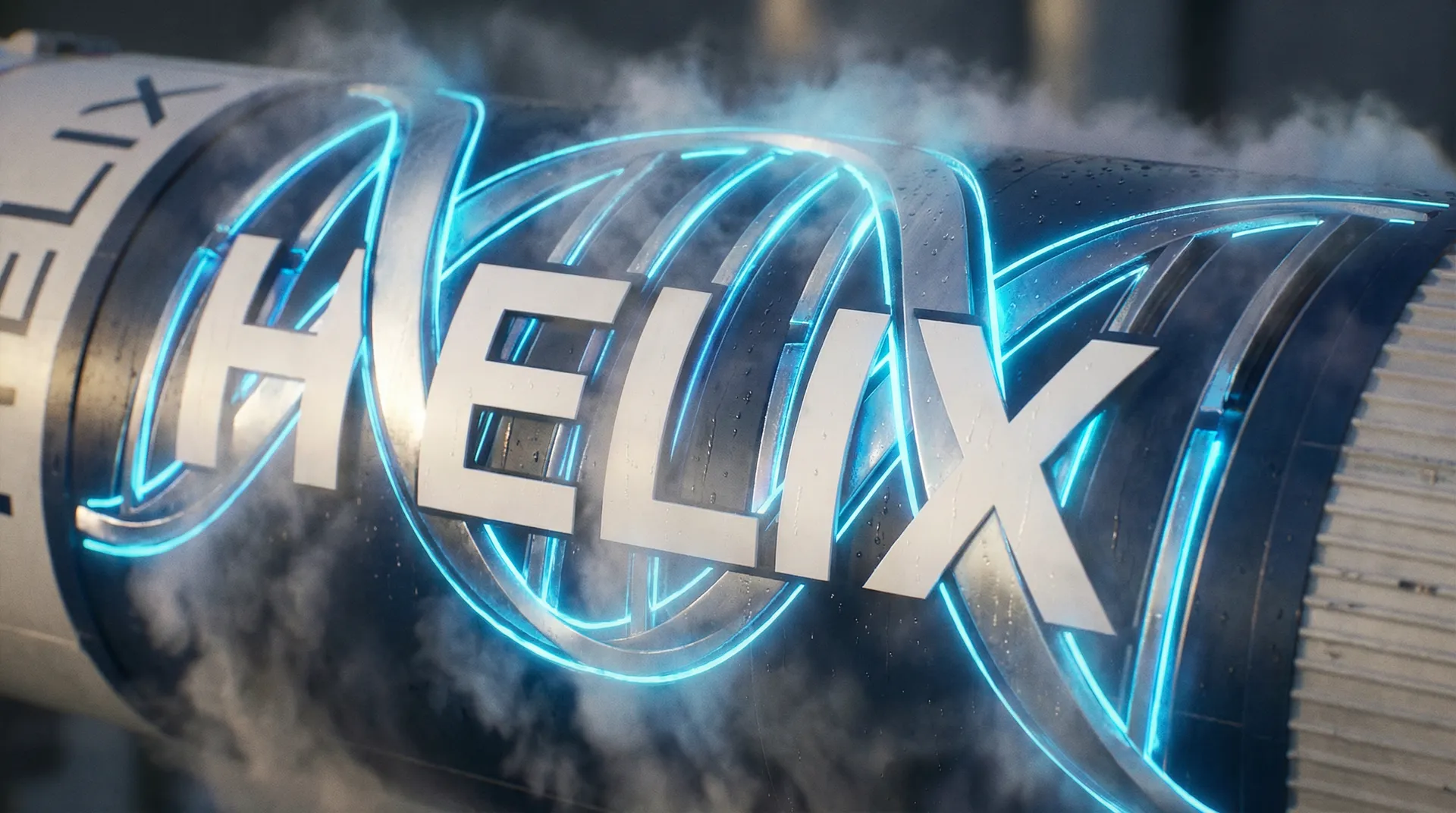
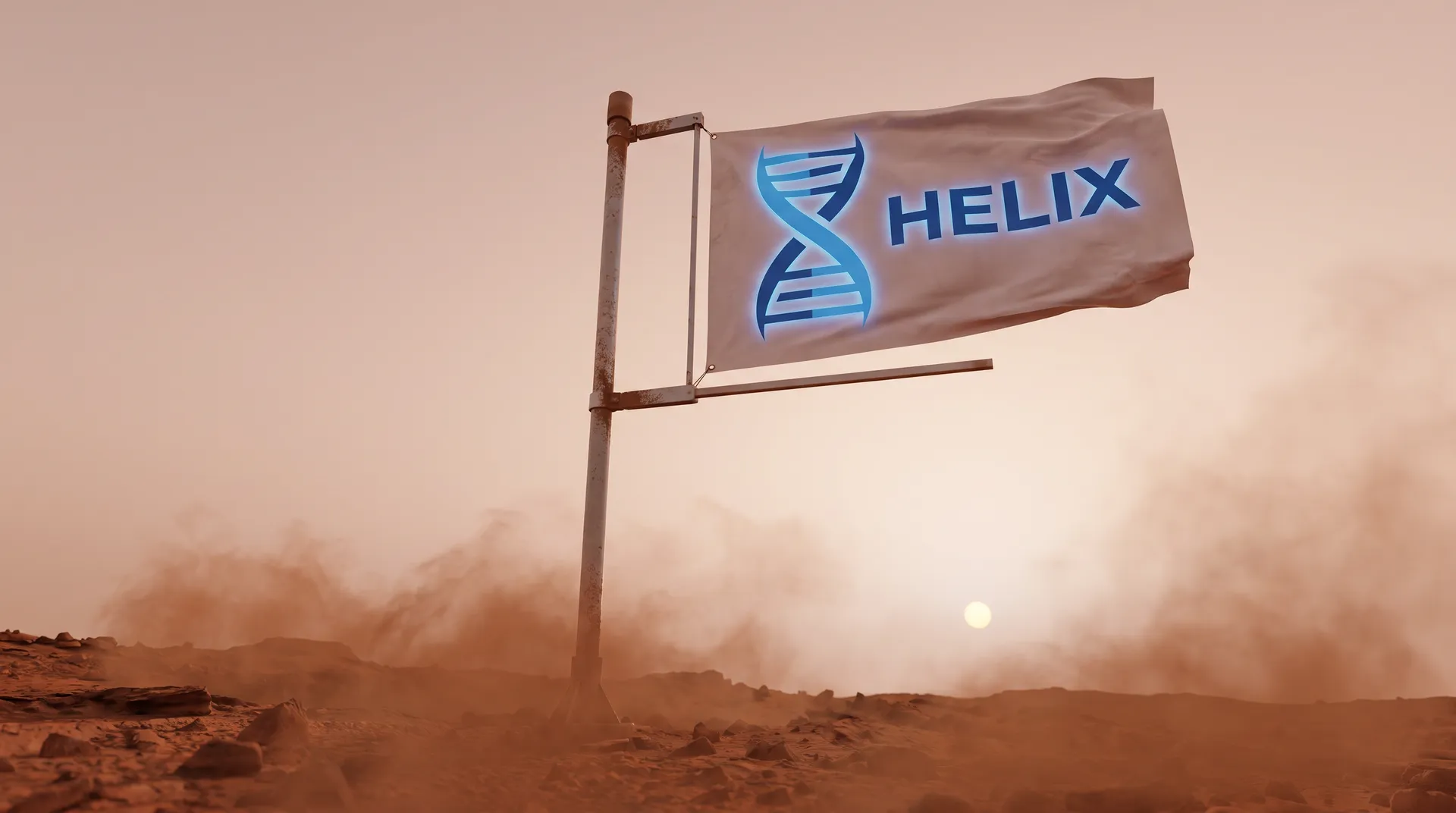
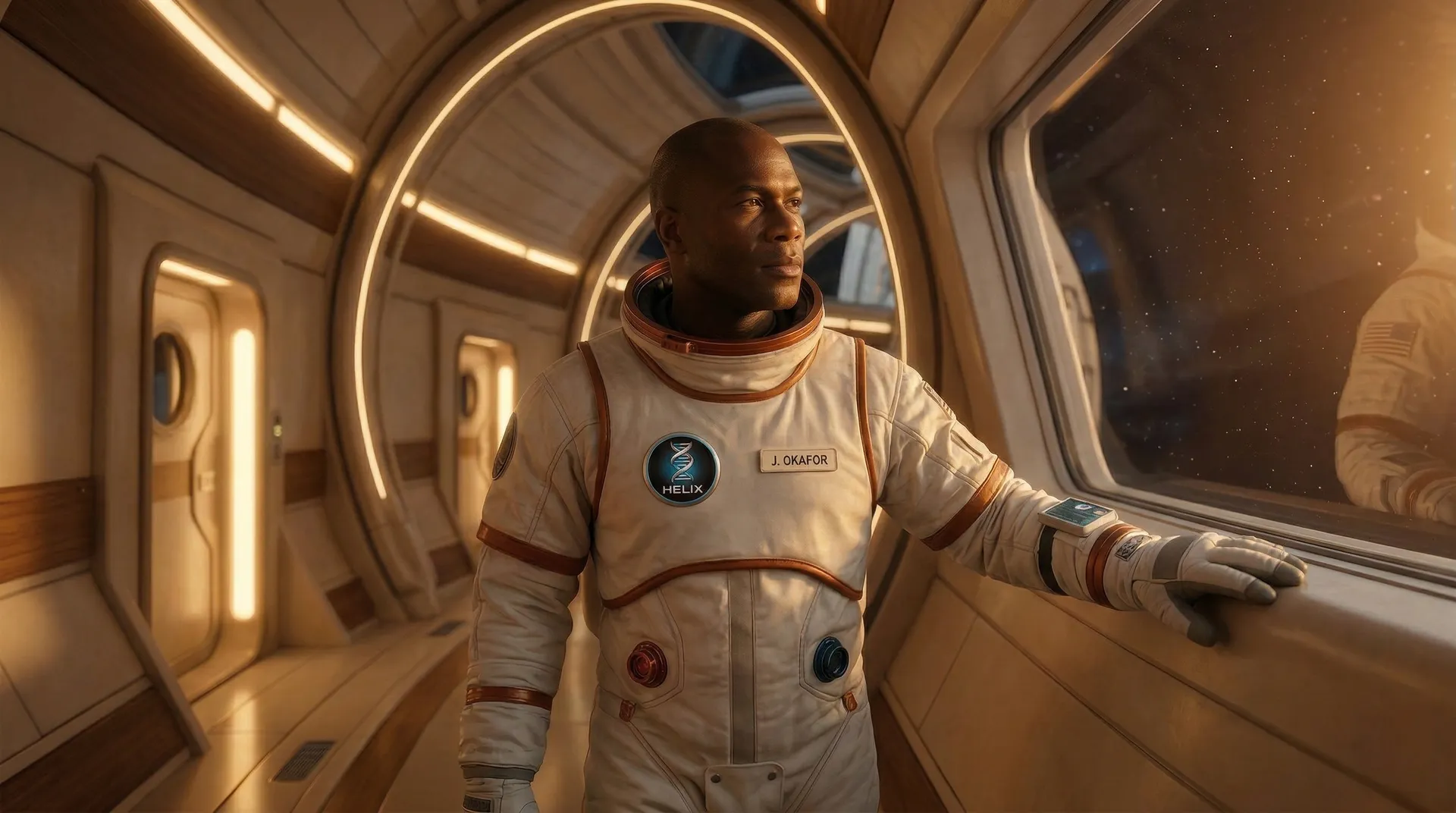
HELIX is the space agency behind every launch, landing and starship in Red Horizon. Its emblem is a double helix spiral, glowing silver and electric blue, worn on the left chest of every suit with a name tag opposite it on the right: L. VASQUEZ, M. PETROV, J. OKAFOR, Y. TANAKA. Its launch facility sits at the edge of a dark treeline where Lena says goodbye to Earth; its rocket is a white two-stage vehicle with HELIX lettered down the body. Its Mission Control is a vast dark room of blue telemetry screens under a lit HELIX logo, where Director Sarah Chen counts down silently and, twenty light-minutes behind the action, learns everything last.
The agency outlives everyone in the first crew. By Track 9 it has a Terraforming Directorate run by Nova's granddaughter; by Track 10 a Council that names the captain of the first ship to leave the solar system. Its flag flies on Mars from Sol 1 and over the spaceport plain three centuries later.
- Colours: electric blue #1E90FF and silver #C0C0C0; burnt orange trim on the first crew's suits.
- Seen in: every track.
The HELIX capsule
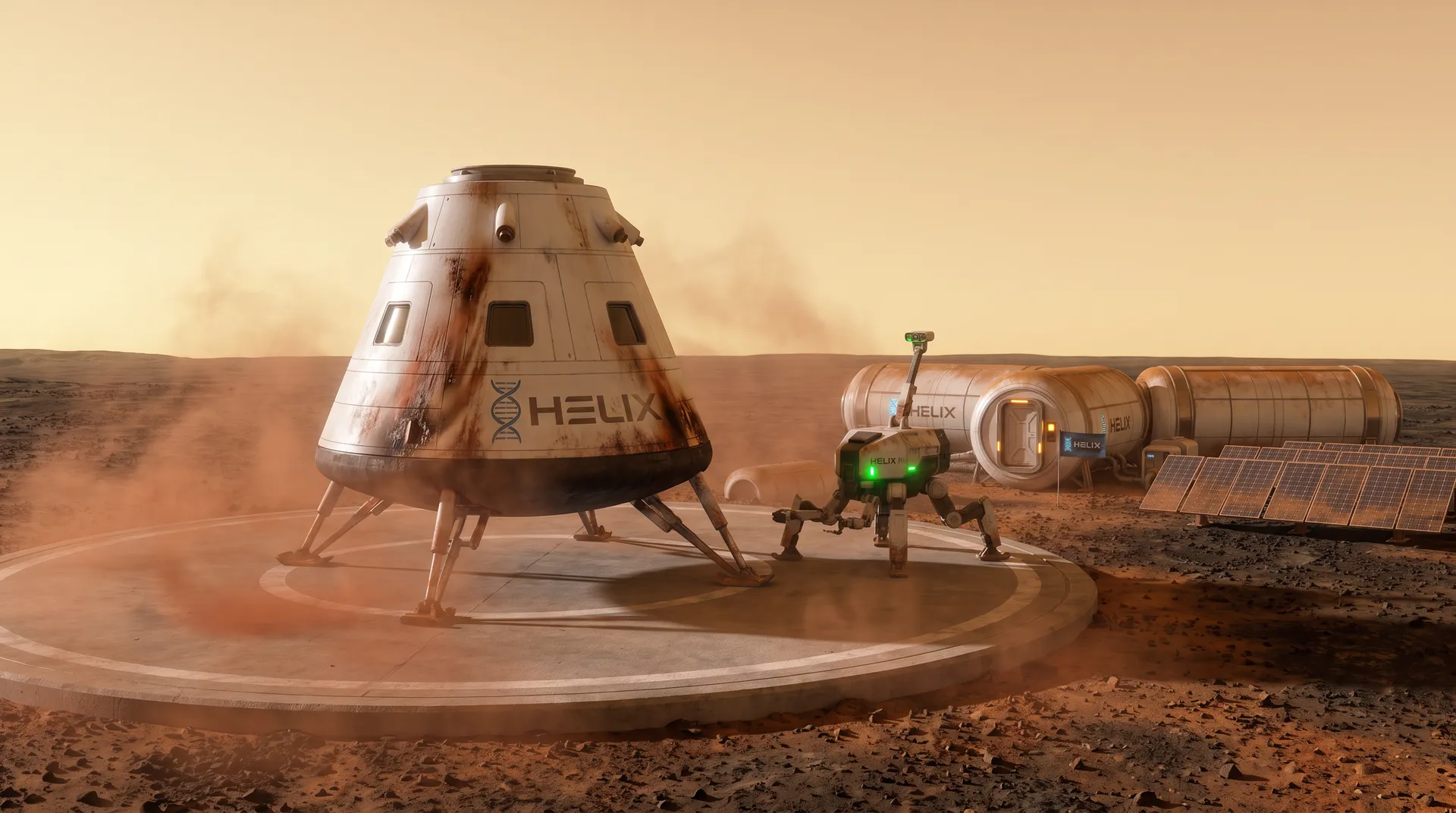
The capsule is the small white craft at the top of the HELIX rocket. It carries the four crew to orbit in Track 2, drifts scorched and boosterless toward the Ares in Track 3, rides docked at the mothership's spine for seven months, and then does the hardest job of the mission in Track 5: undocking, turning heat shield first, falling through plasma and a four-minute blackout, and landing on retro-rockets in a ring of red dust beside the outpost. The crew's first view of Mars from the ground is through its small window, and the green light by its hatch is the last shot of Track 5 and the first beat of Track 6.
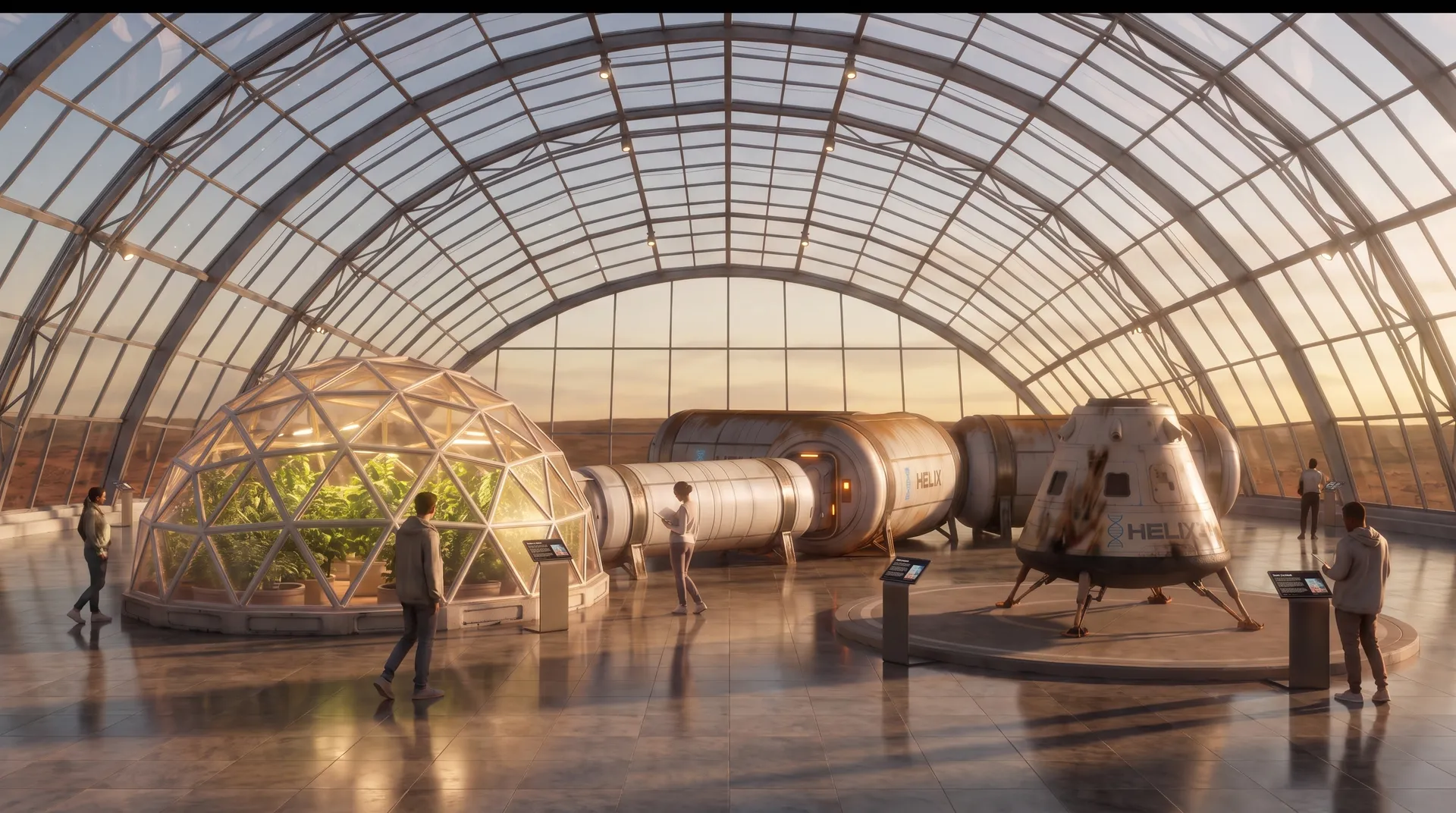
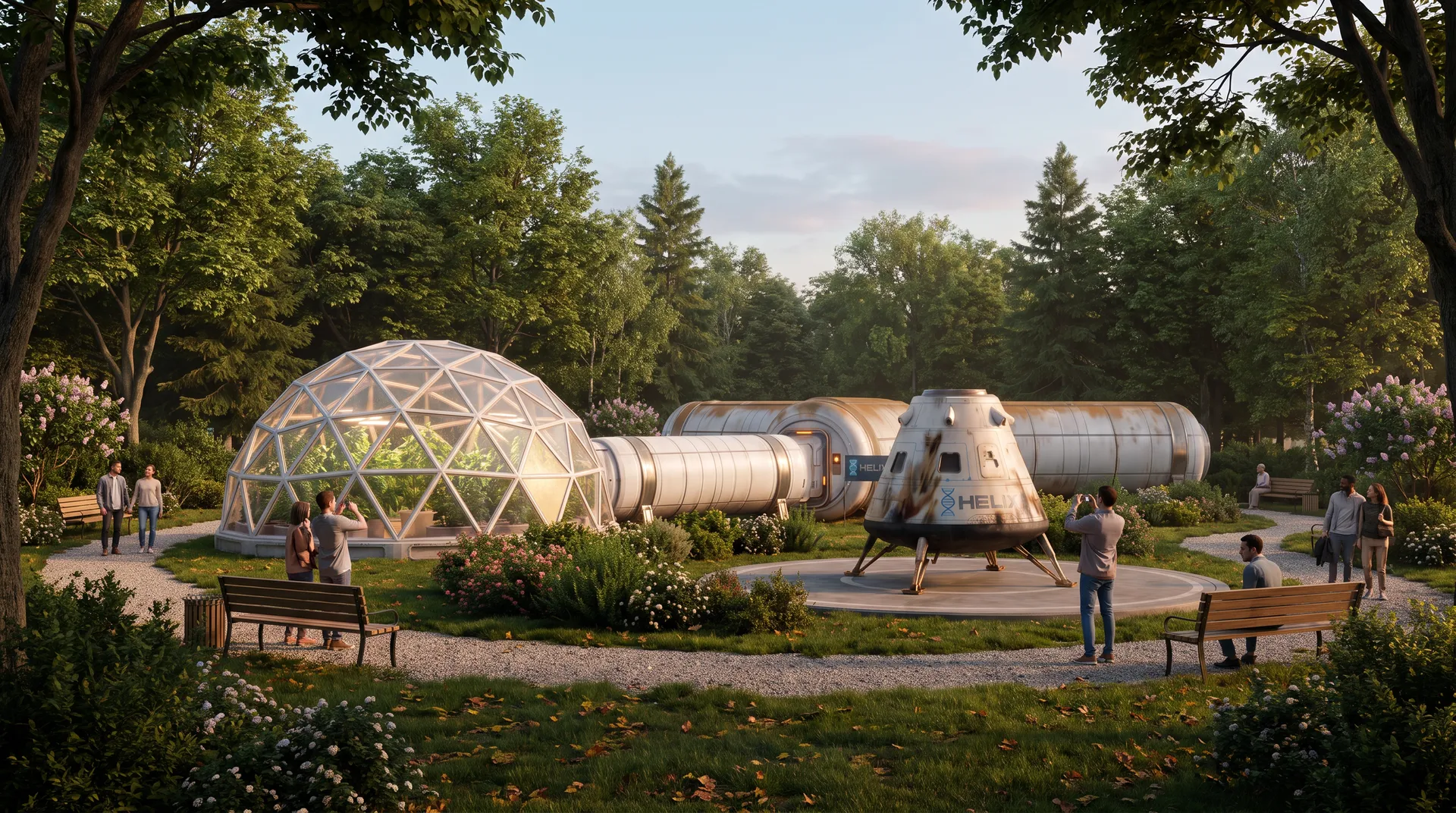
It never flies again. It stands beside the outpost through the dome build and Nova's childhood, is preserved under the museum's glass roof in Track 9, and sits in a green park beneath tall trees in Track 10.
- Seen in: Tracks 2, 3, 4, 5, 6, 7, 8, 9, 10.
The HELIX Ares
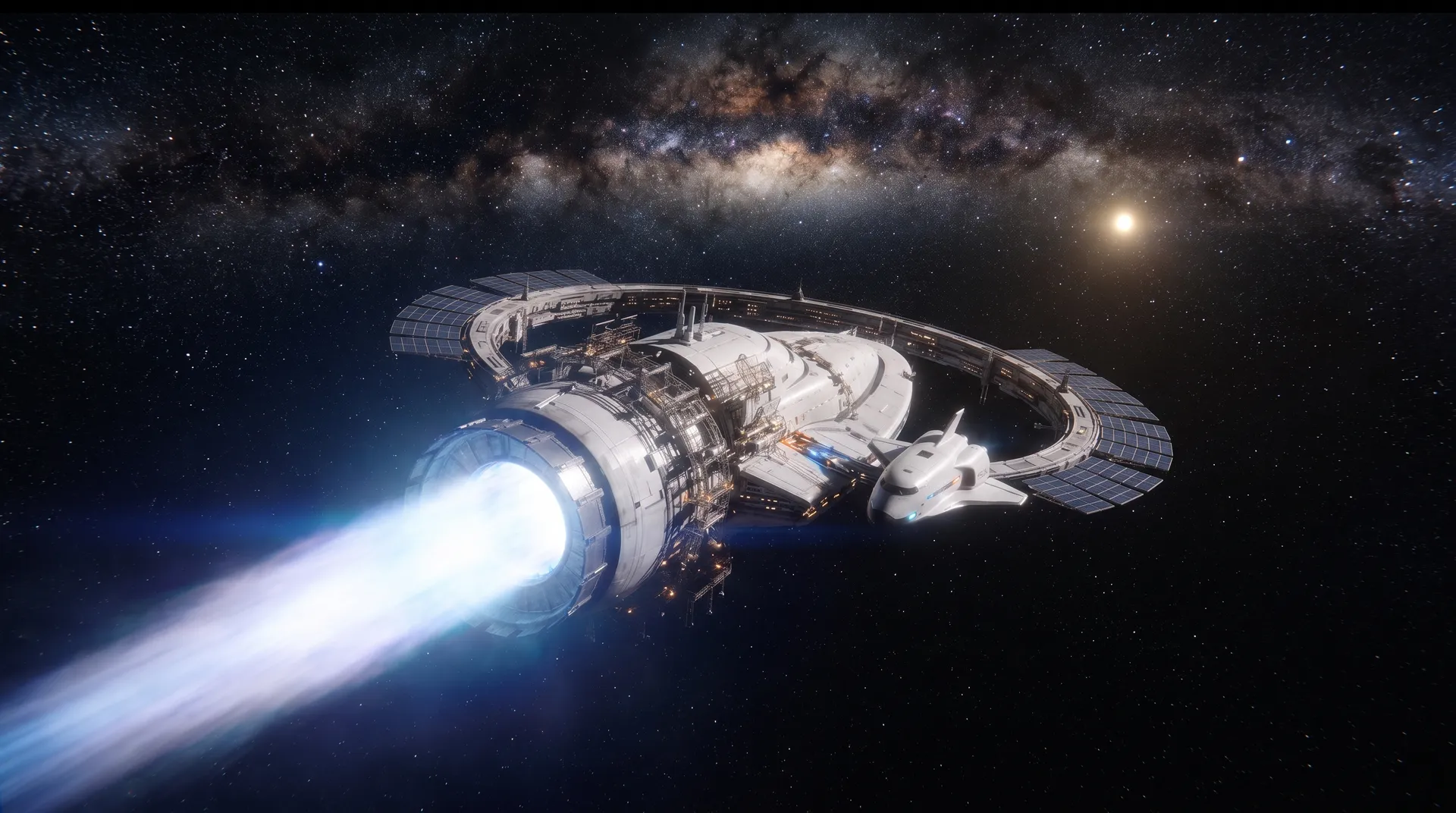
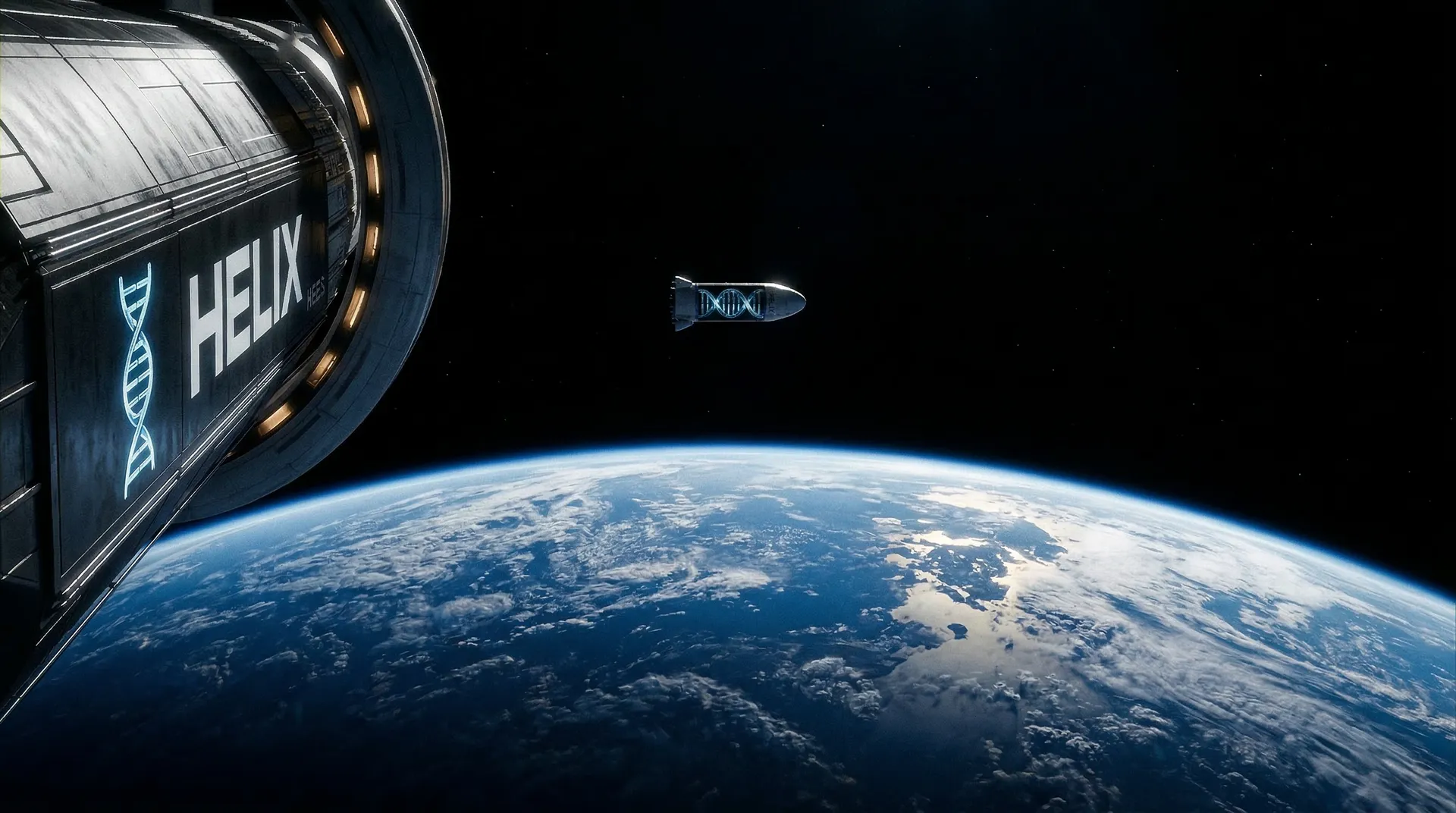
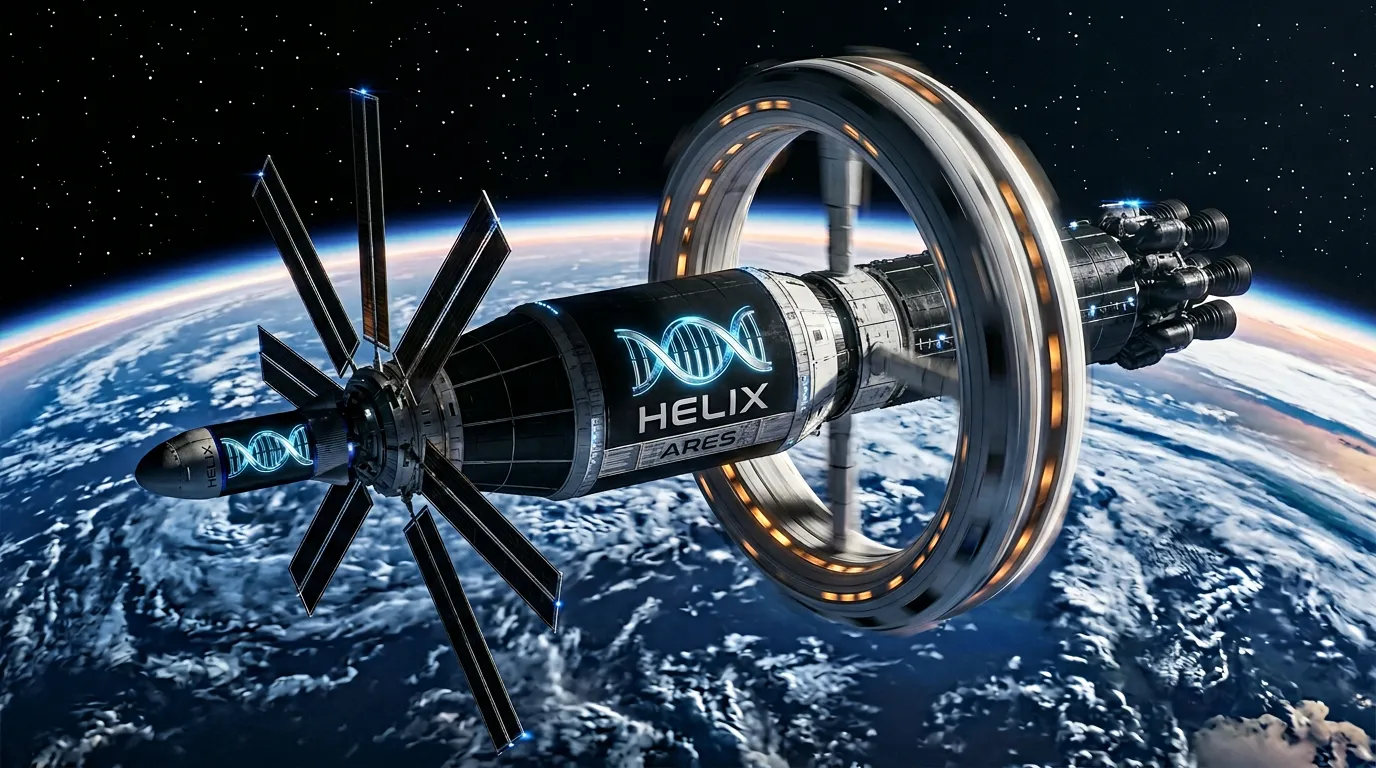
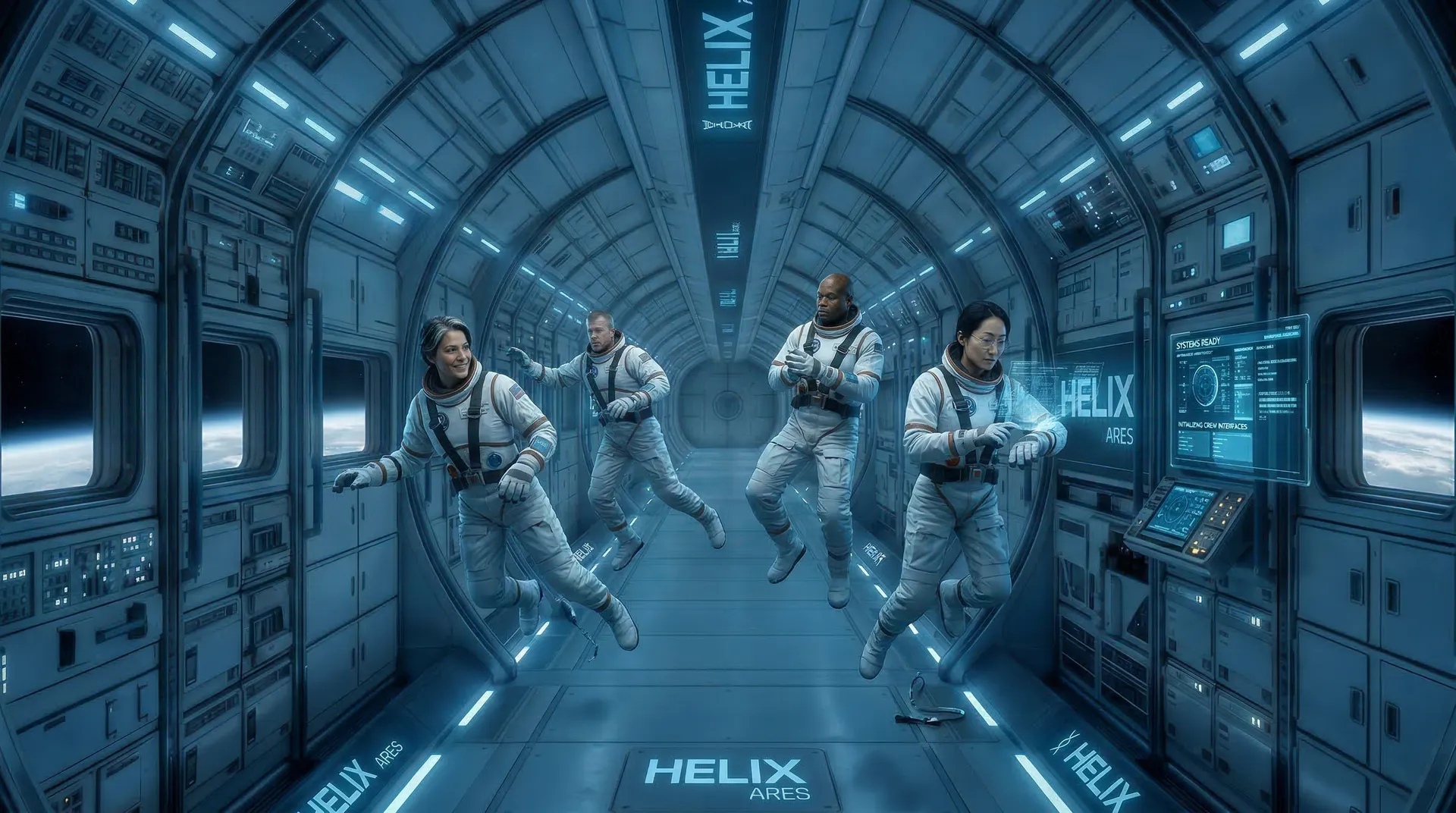
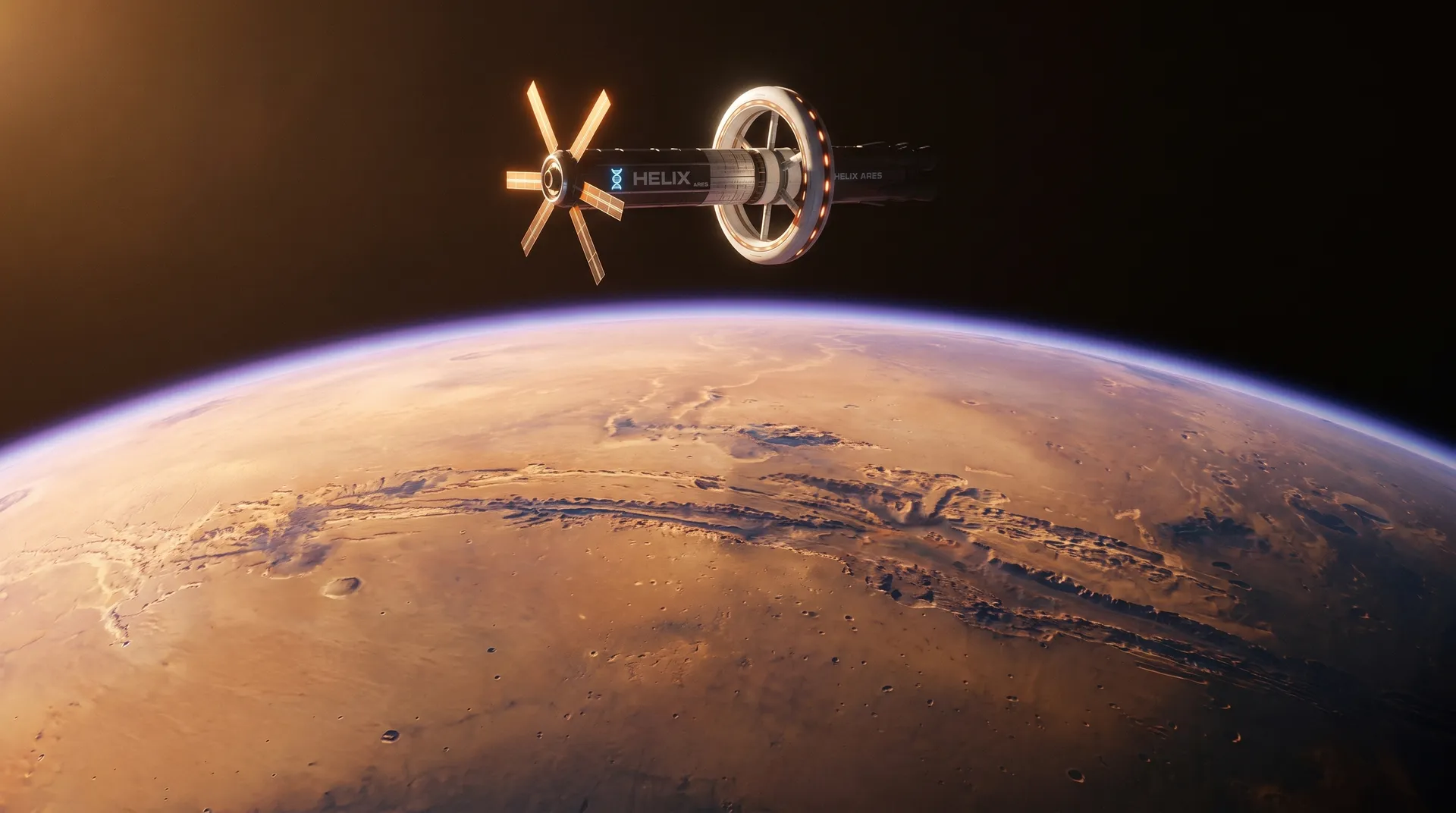
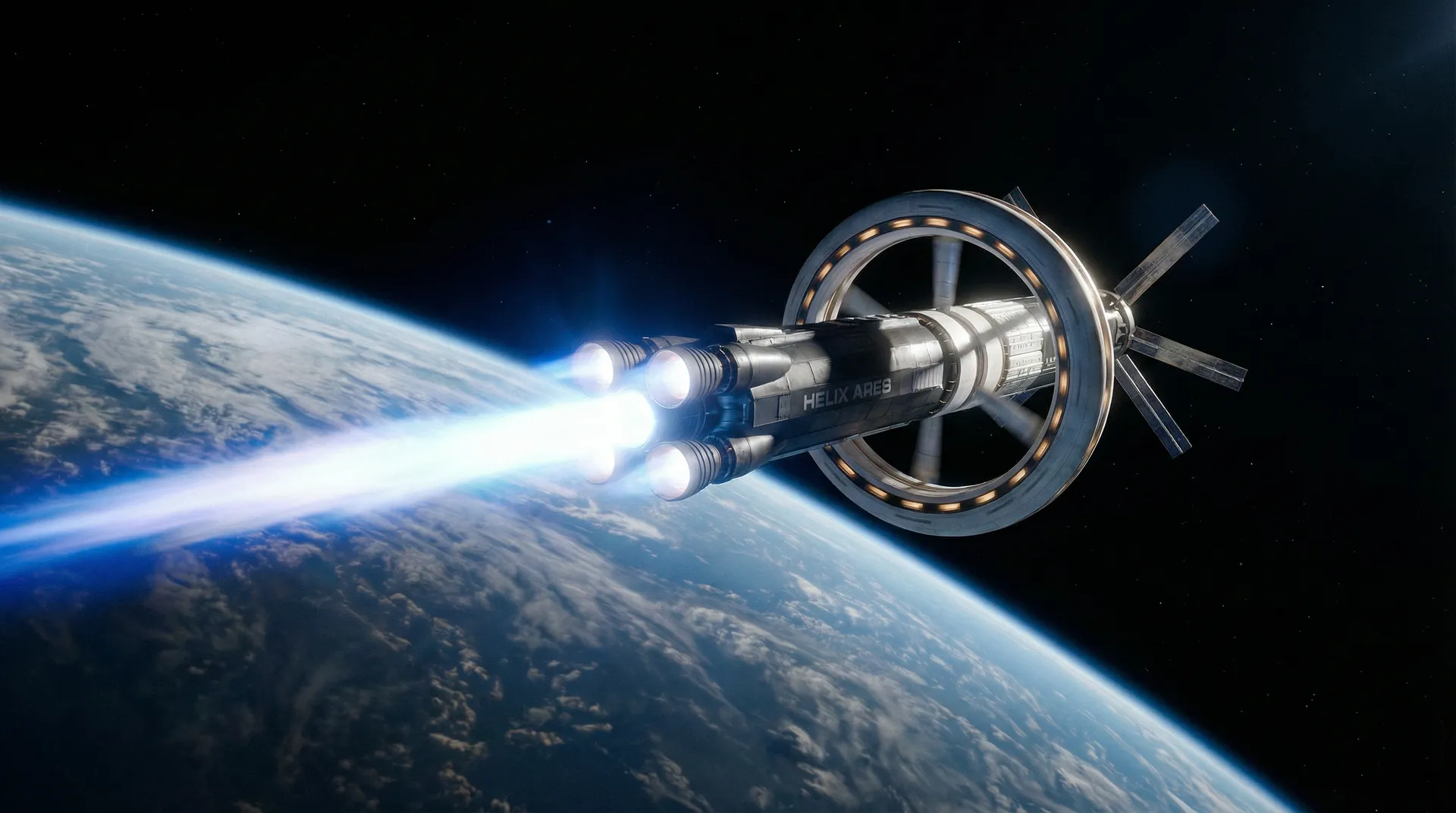
The Ares is the ship that waits in Earth orbit for the capsule to find it: a long central spine with a rotating torus habitat ring for artificial gravity, solar arrays spread wide, a docking port at its forward end. It was assembled in orbit for exactly this voyage. Inside, the spine is a zero-gravity corridor of blue instrument lighting and equipment racks; a circular hatch in its floor leads down into the ring, where weight returns and a warm white corridor curves upward in both directions. The ring holds the common area with its briefing console, a science module where Yuki keeps six smuggled plants, an exercise module, and the crew's bunks.
The Ares is home for the seven months of The Long Silence and the stage for the whole of Ghost Planet. It fires its main engines once on screen, a long burn seen from outside with the ring still turning, and it is left in Mars orbit when the capsule undocks in Track 5. Lena's palm touches its viewport twice.
- Seen in: Tracks 3, 4, 5.
The outpost
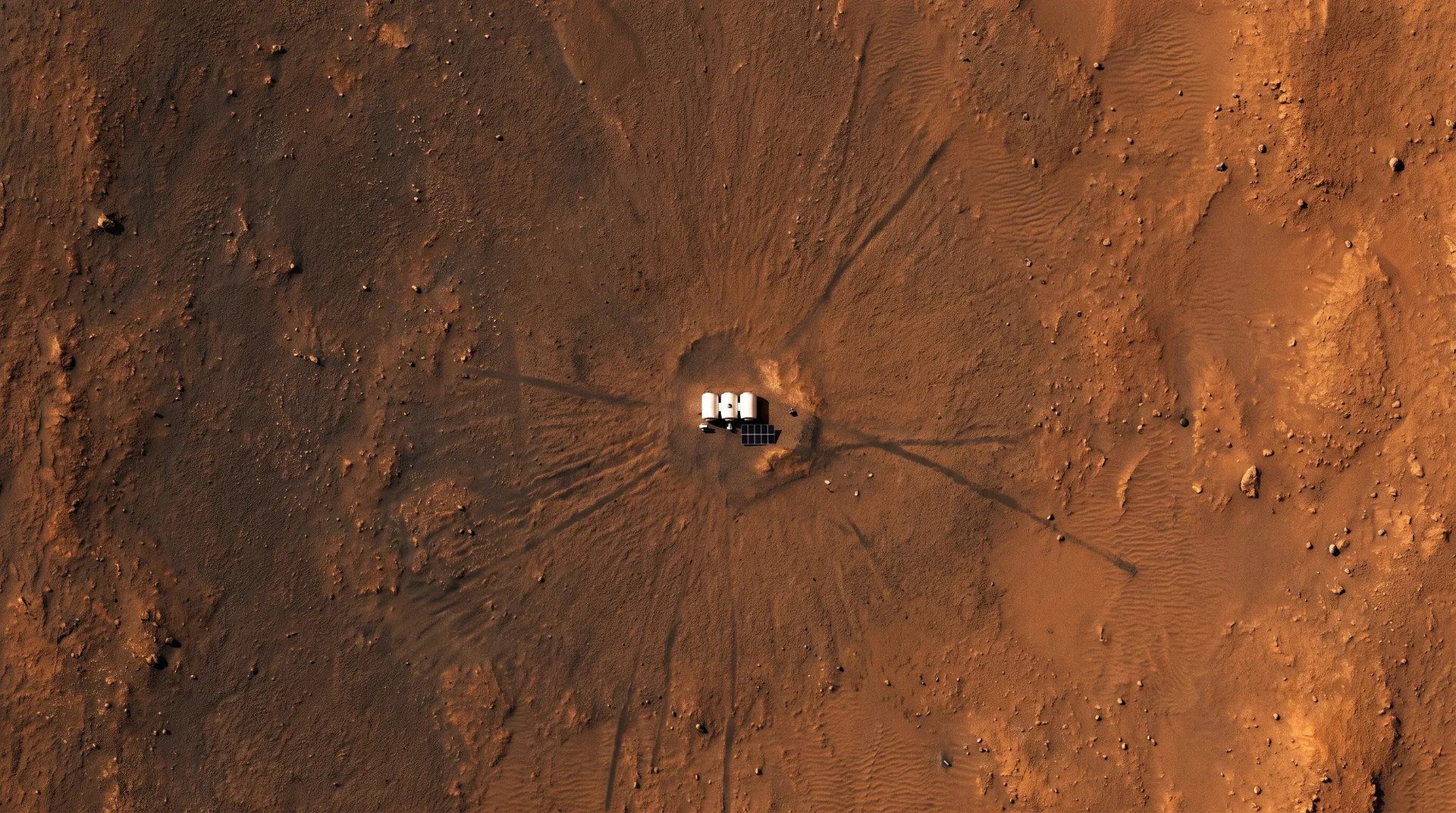
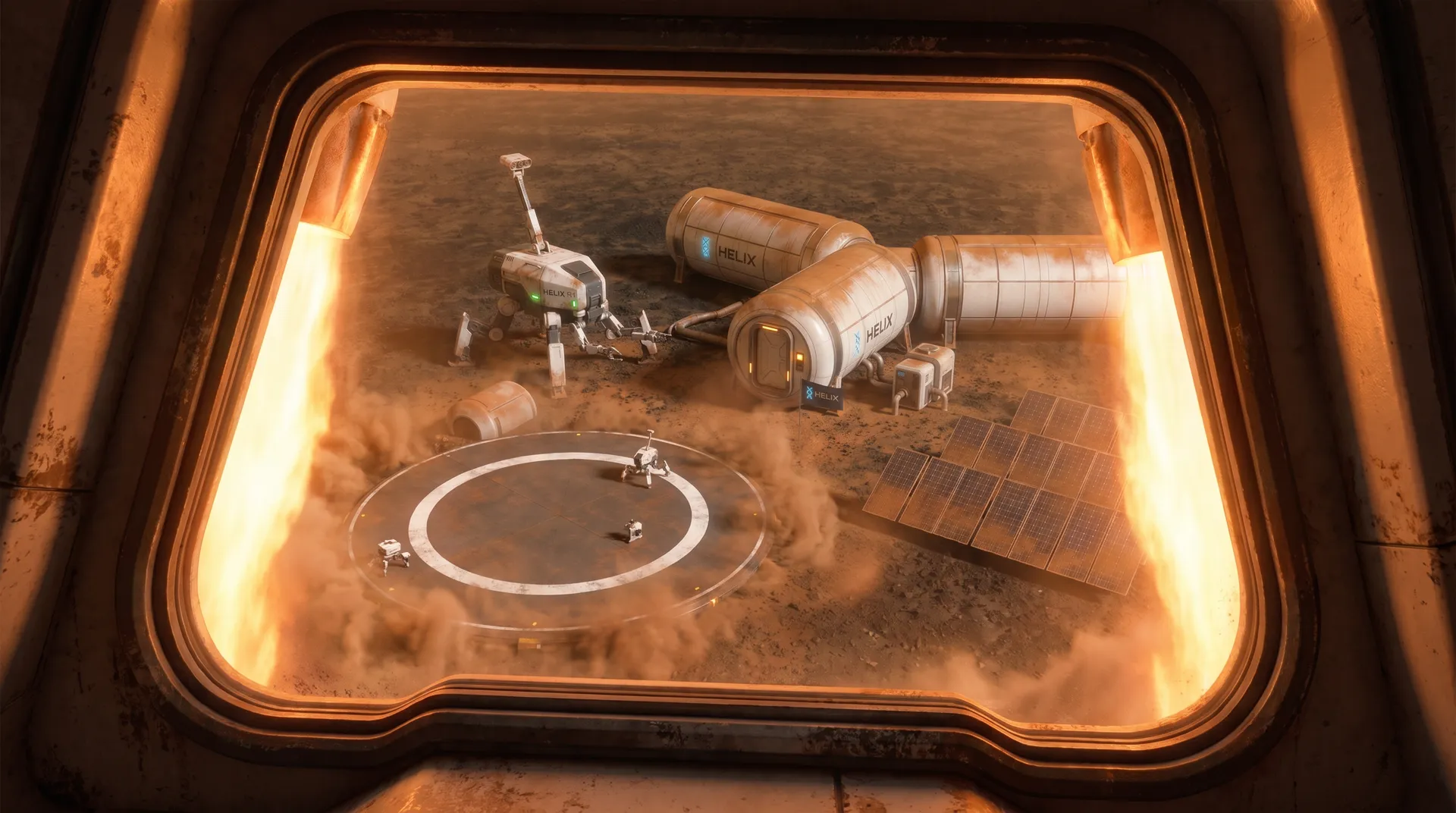
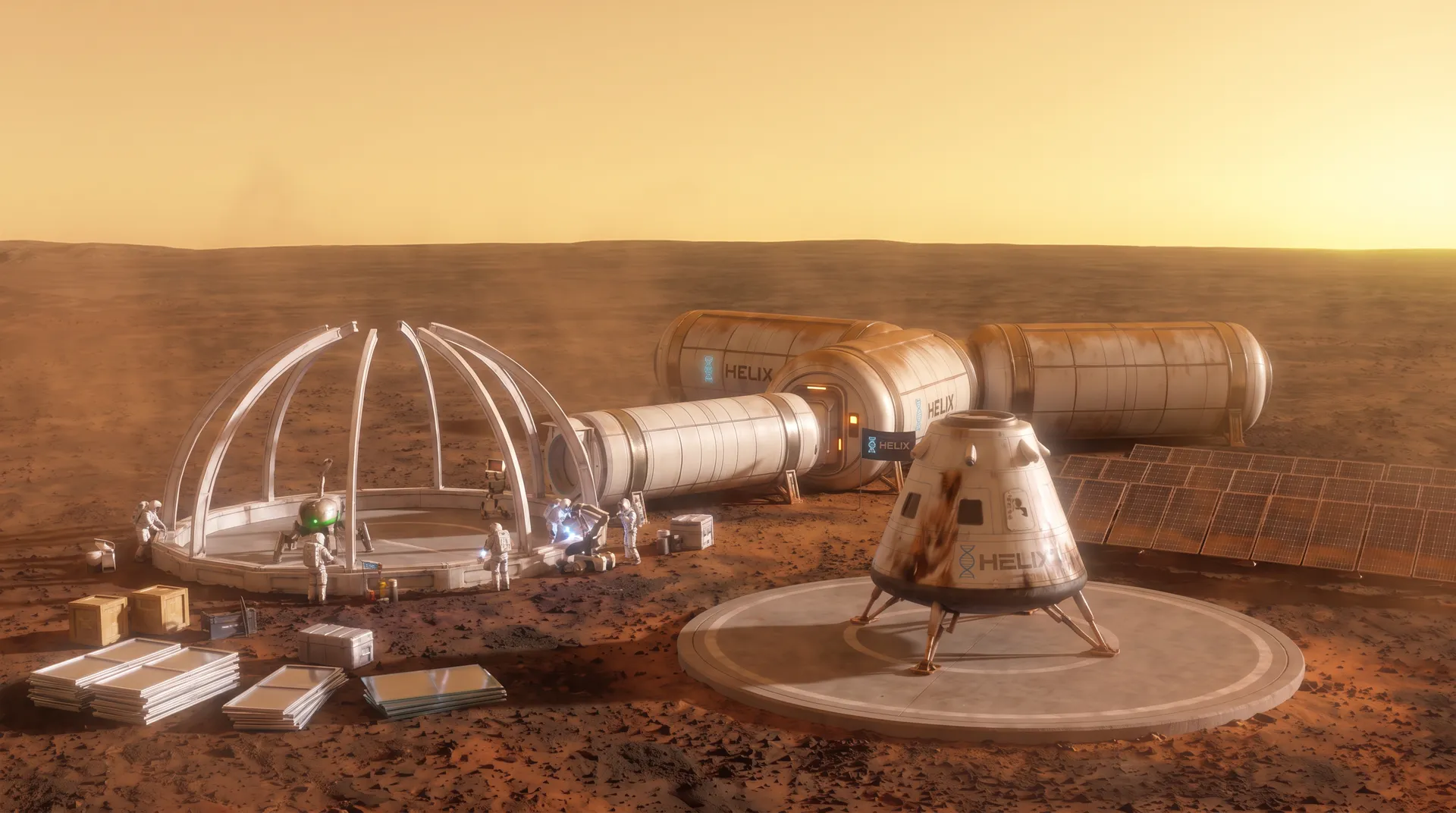
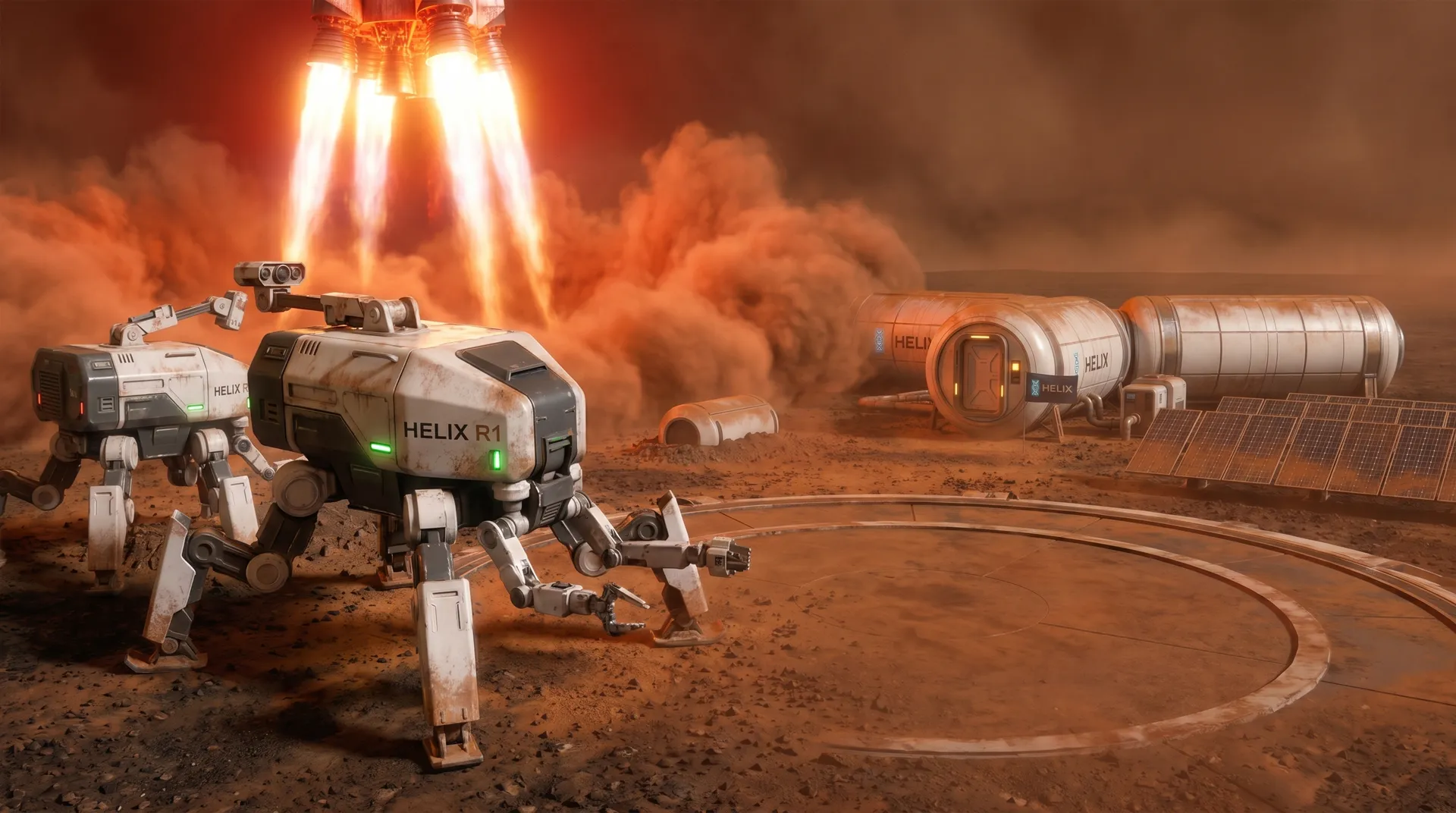
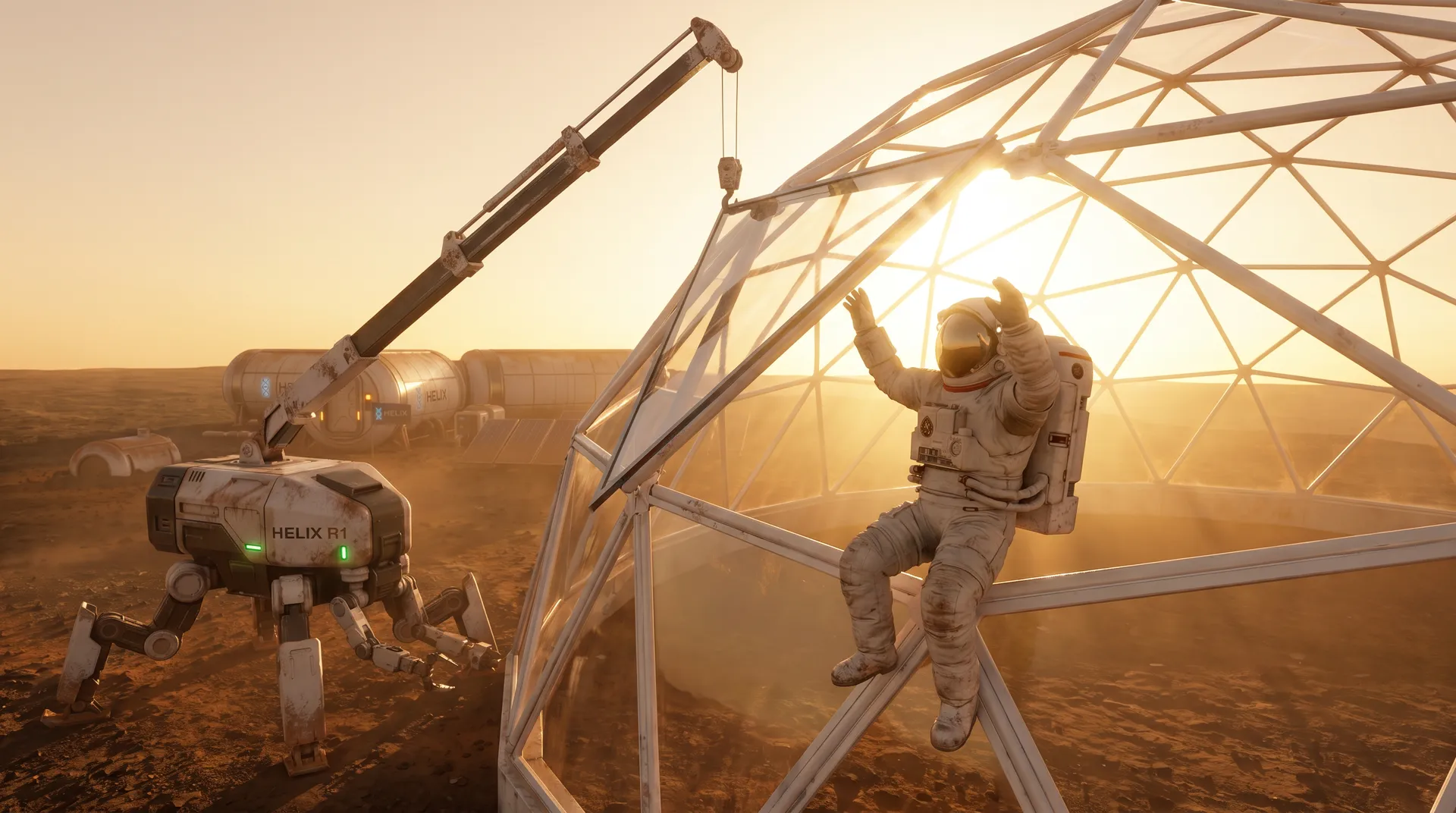
Two years before the crew land, six HELIX robots touch down on a flat, dark, ancient lava plain and build a home: habitat modules, an oxygen generator, a hydroponic bay, a nuclear micro-reactor, solar arrays and a landing pad swept clean. From orbit it is a cluster of pale shapes on dark ground; from the capsule window it is domes and arrays with small metal figures gathered at the edge. The crew add its most important building themselves in Track 7, the greenhouse dome, raised in a single day from ribs and glass panels before a dust storm closes in. Inside it they take their first unhelmeted breath on Mars and plant the first seedling.
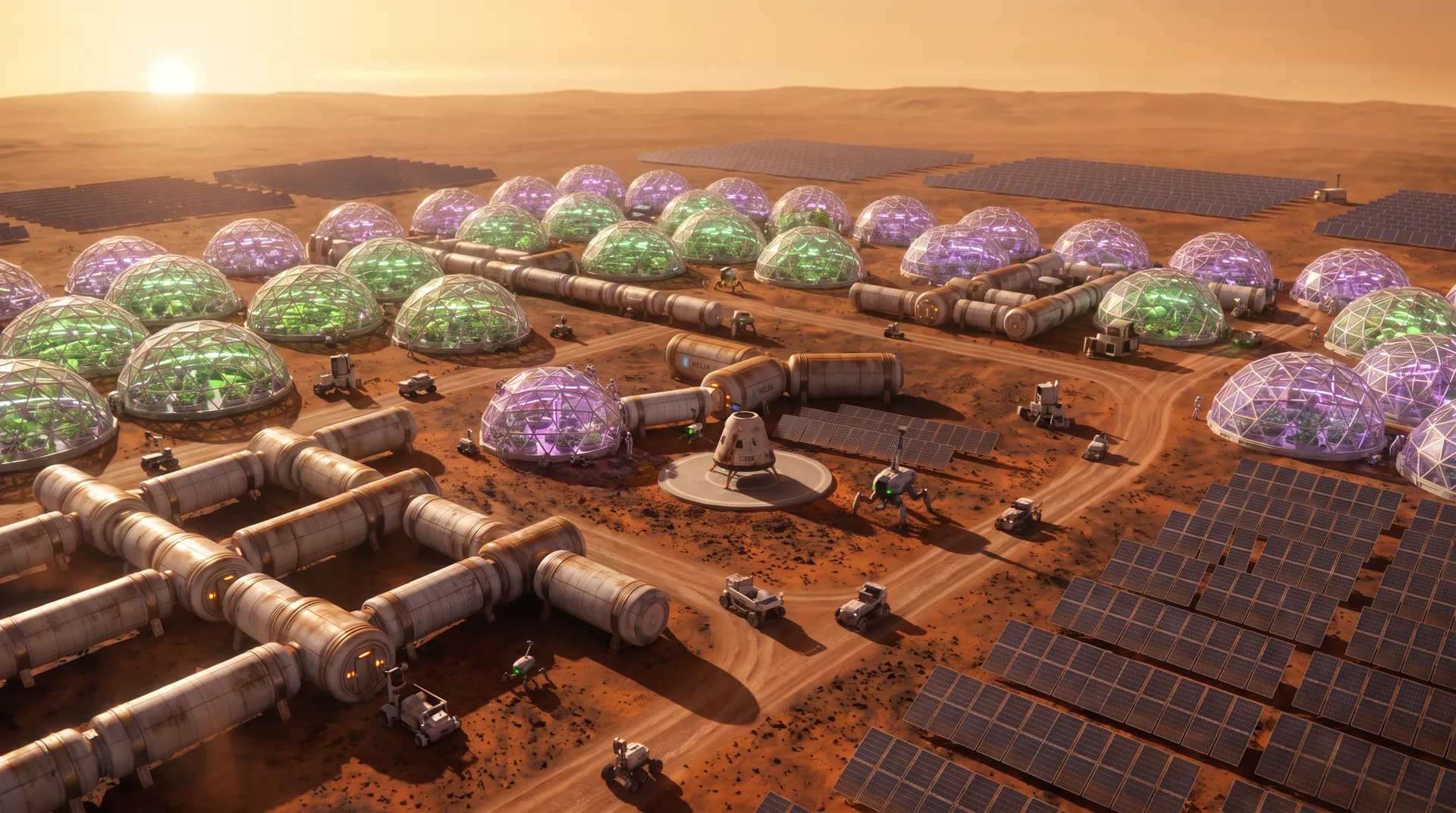
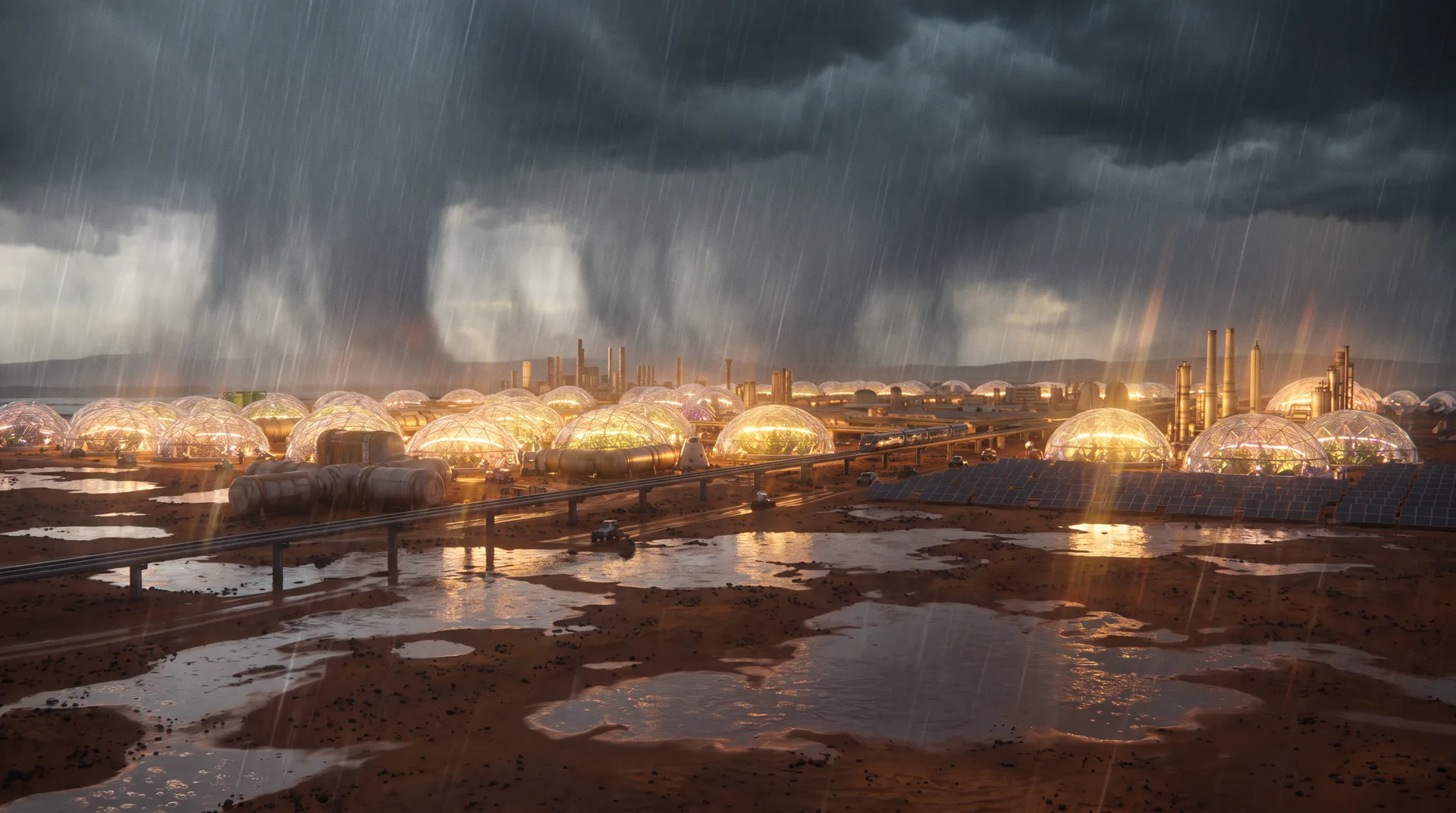
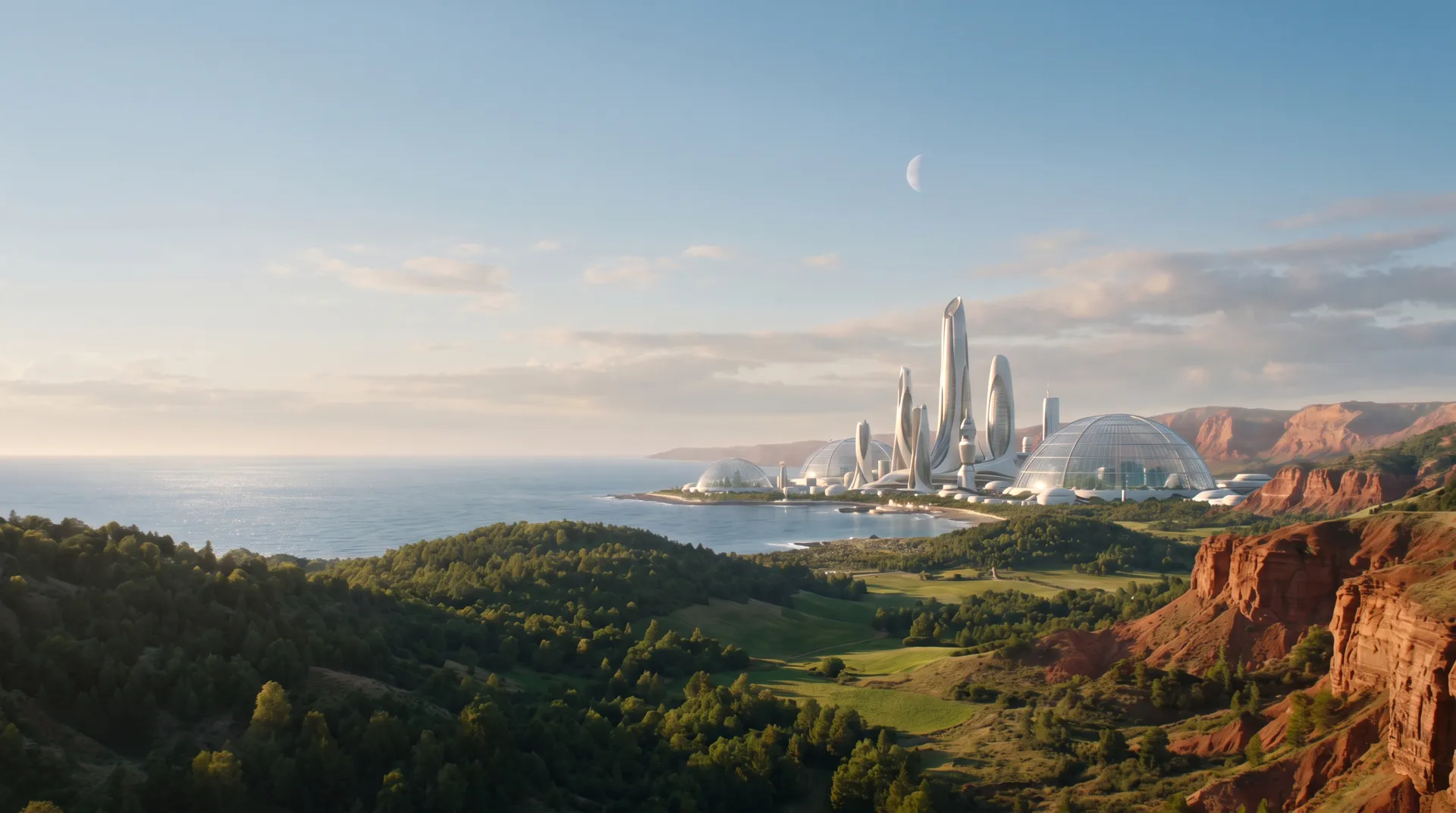
The outpost grows. By the end of Track 8 it is a colony of many domes, habitats, roads and solar fields receiving its first ship from Earth. By Track 9 it is the preserved heart of a domed city, a museum with the capsule and the greenhouse under one great roof. By Track 10 it is a quiet park, and the oldest thing on a planet with seas.
- Seen in: Tracks 3 (on a screen), 4, 5, 6, 7, 8, 9, 10.
The robots: HELIX-R1 to R6
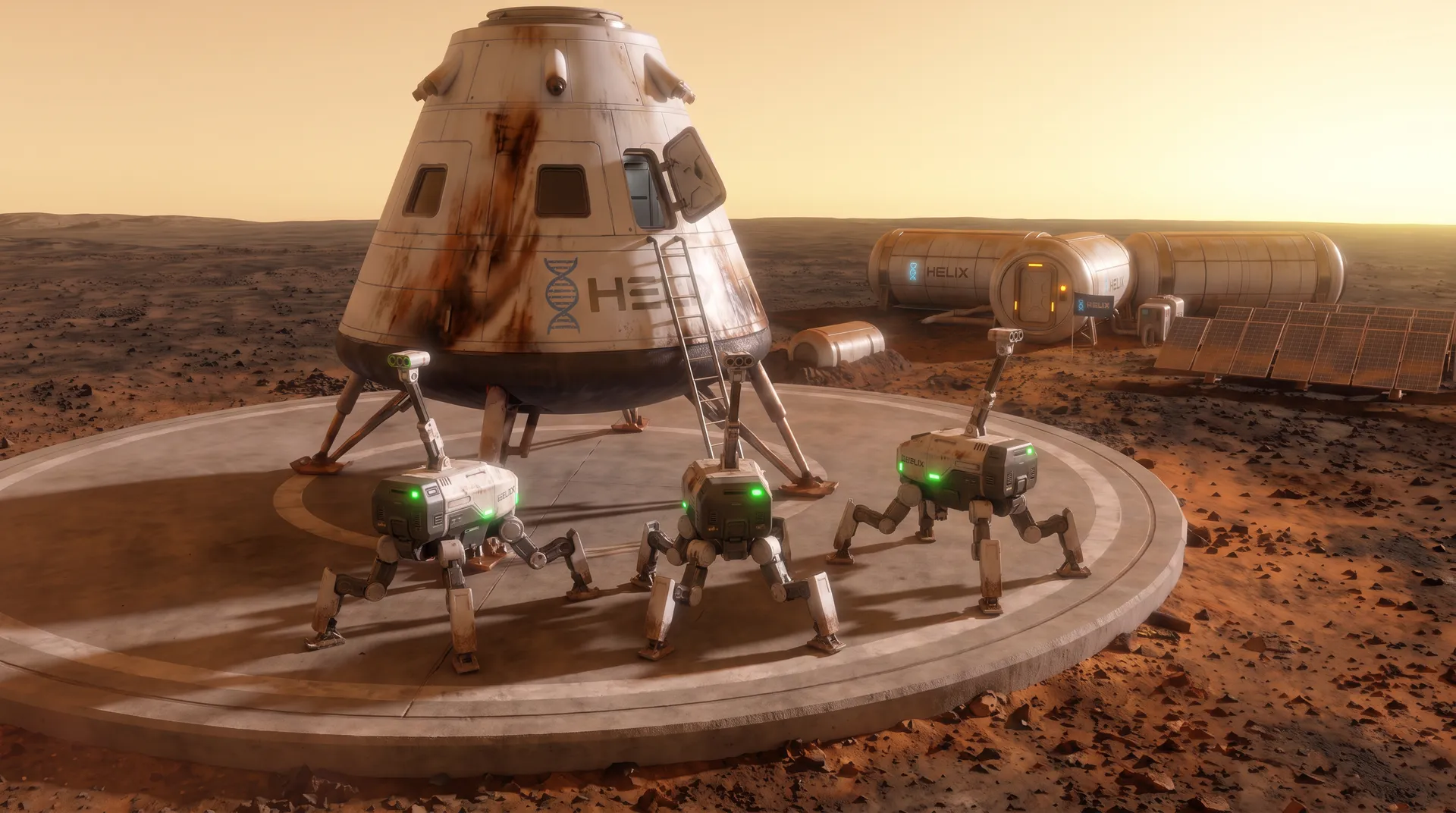
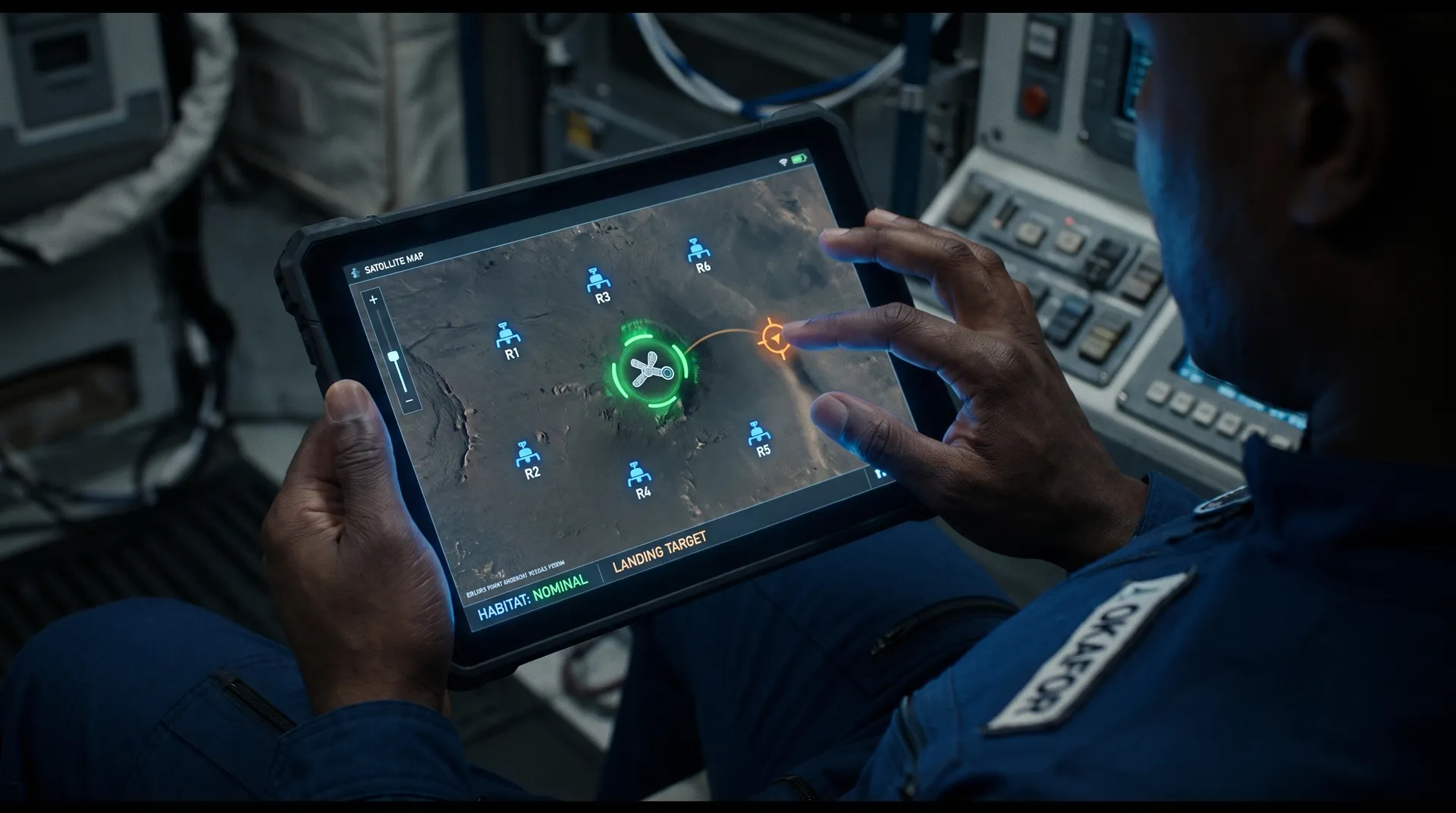
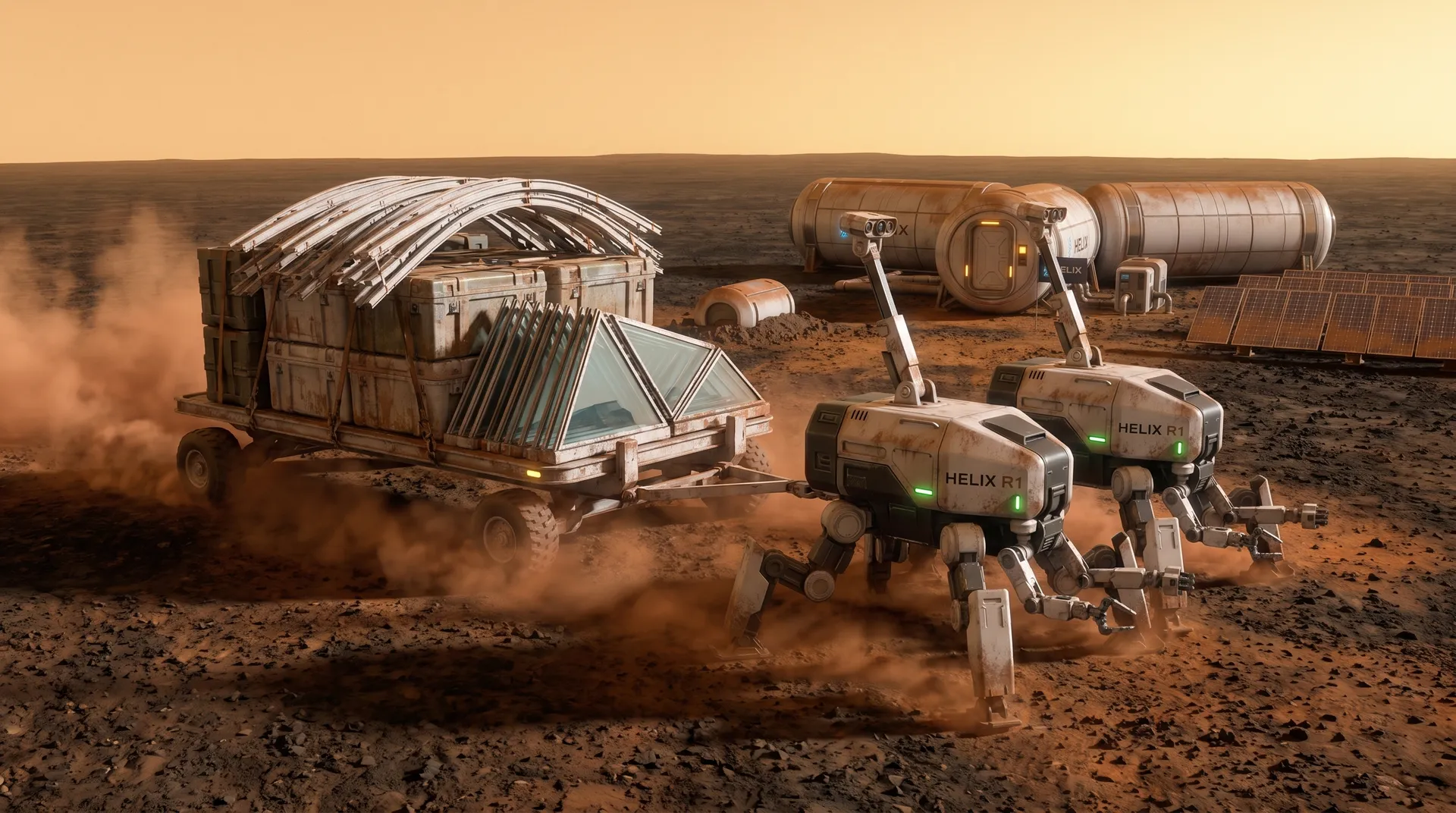
Six autonomous construction units, large and four-legged, with tilting heads and status lights. They land two years ahead of the crew and build the outpost unsupervised, reporting back a survey map that reads habitat nominal, reactor nominal, hydroponics nominal. During the landing they shield their sensors as the dust lifts; on Sol 1 they wait at the foot of the ladder in a loose semicircle; during the dome build they tow the cargo sled, raise the ribs and crane the glass panels into place.
R1 is the one with a story. It establishes the uplink that makes James weep, watches the capsule's fireball cross the dawn sky, holds still under Lena's hand, hands James tools like a coworker, stands guard under the Milky Way, prints a toy rocket for a newborn, carries two-year-old Nova through the greenhouse, is still at Nova's side a hundred years later, patched and chirping, and rests at last in a glass case in the memorial plaza with a six-year-old's nose against the glass. R1 has its own character page.
- Seen in: Tracks 3 (on a screen), 4, 5, 6, 7, 8, 9, 10.
Terraforming
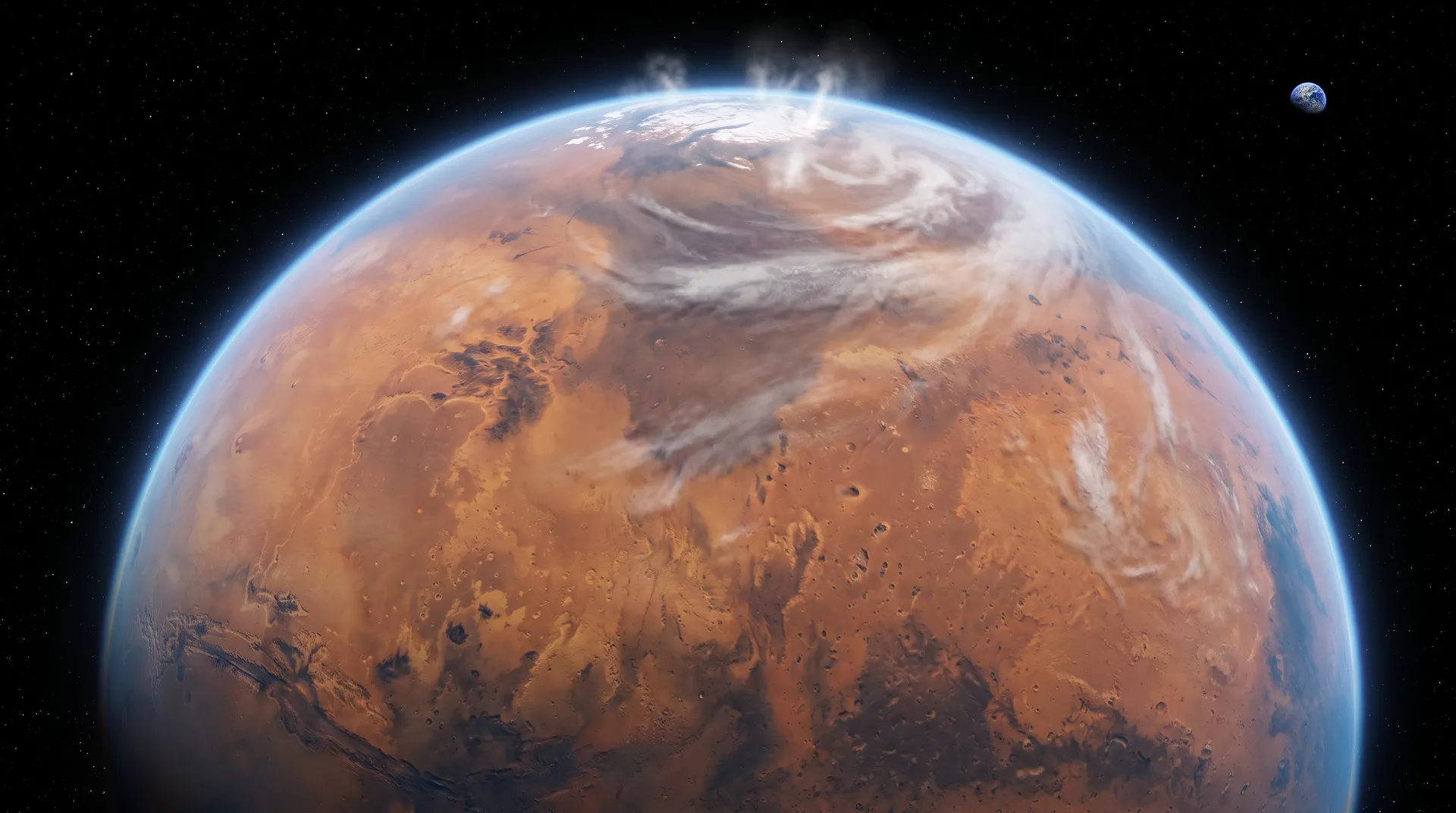
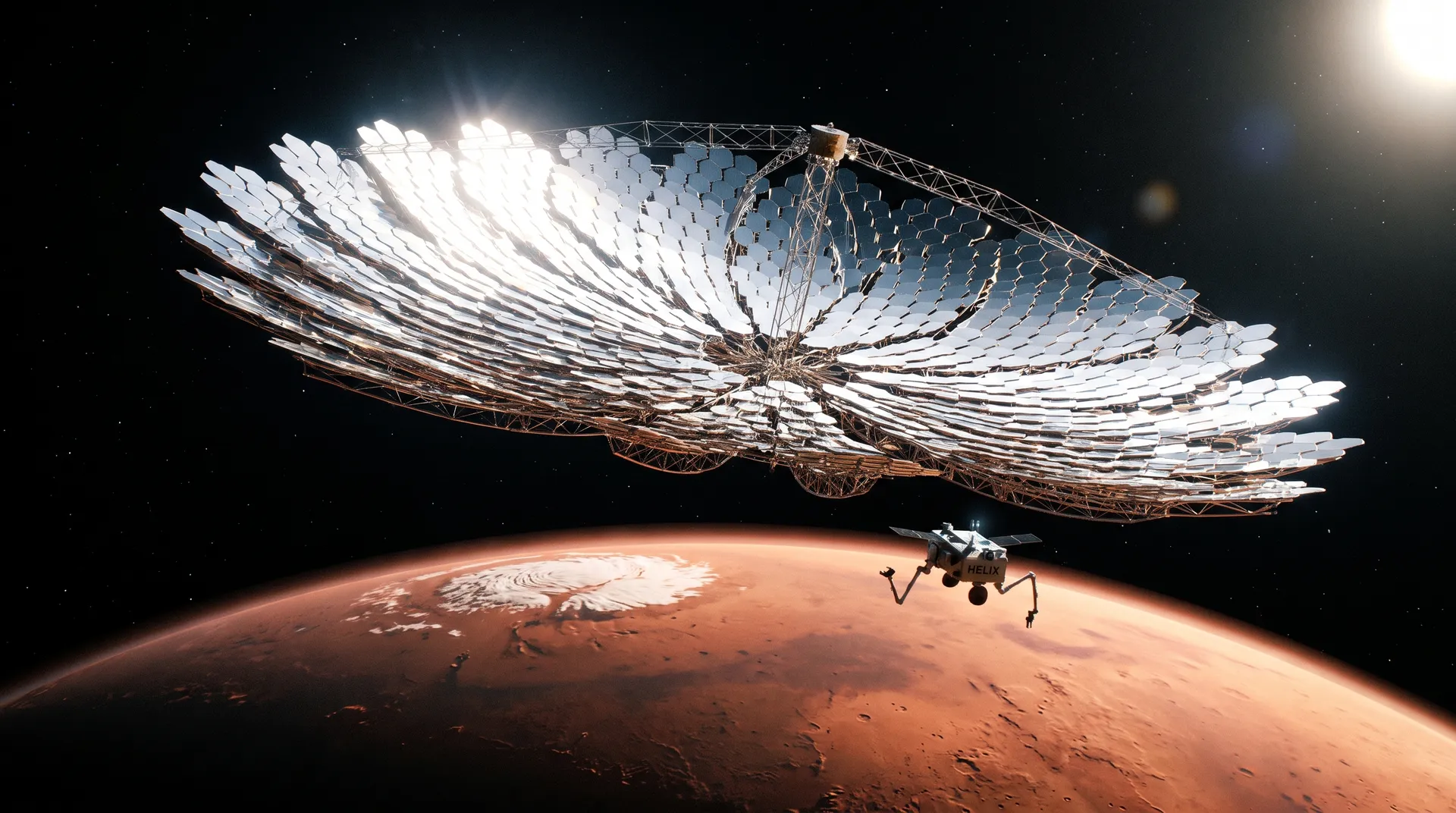
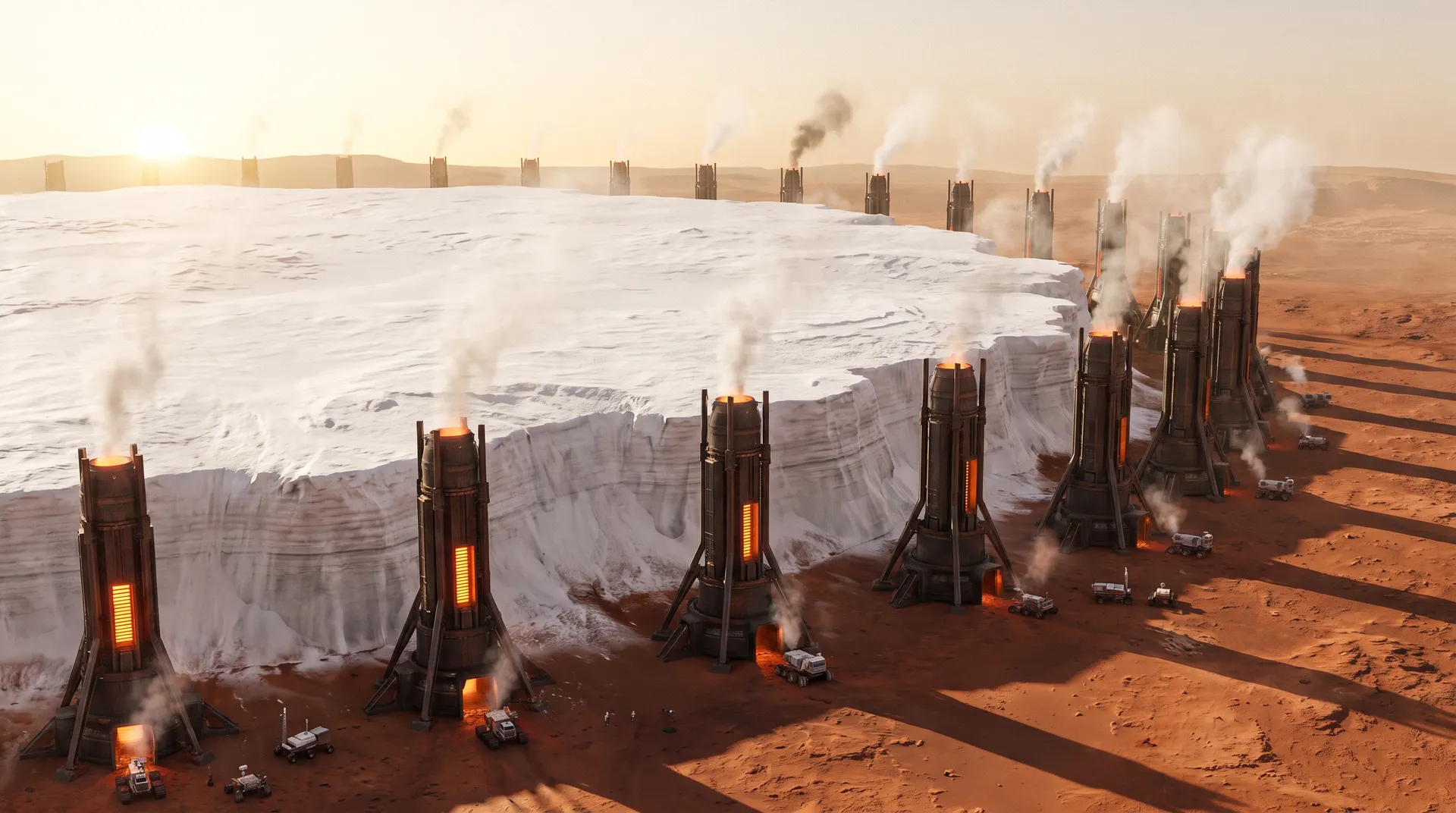
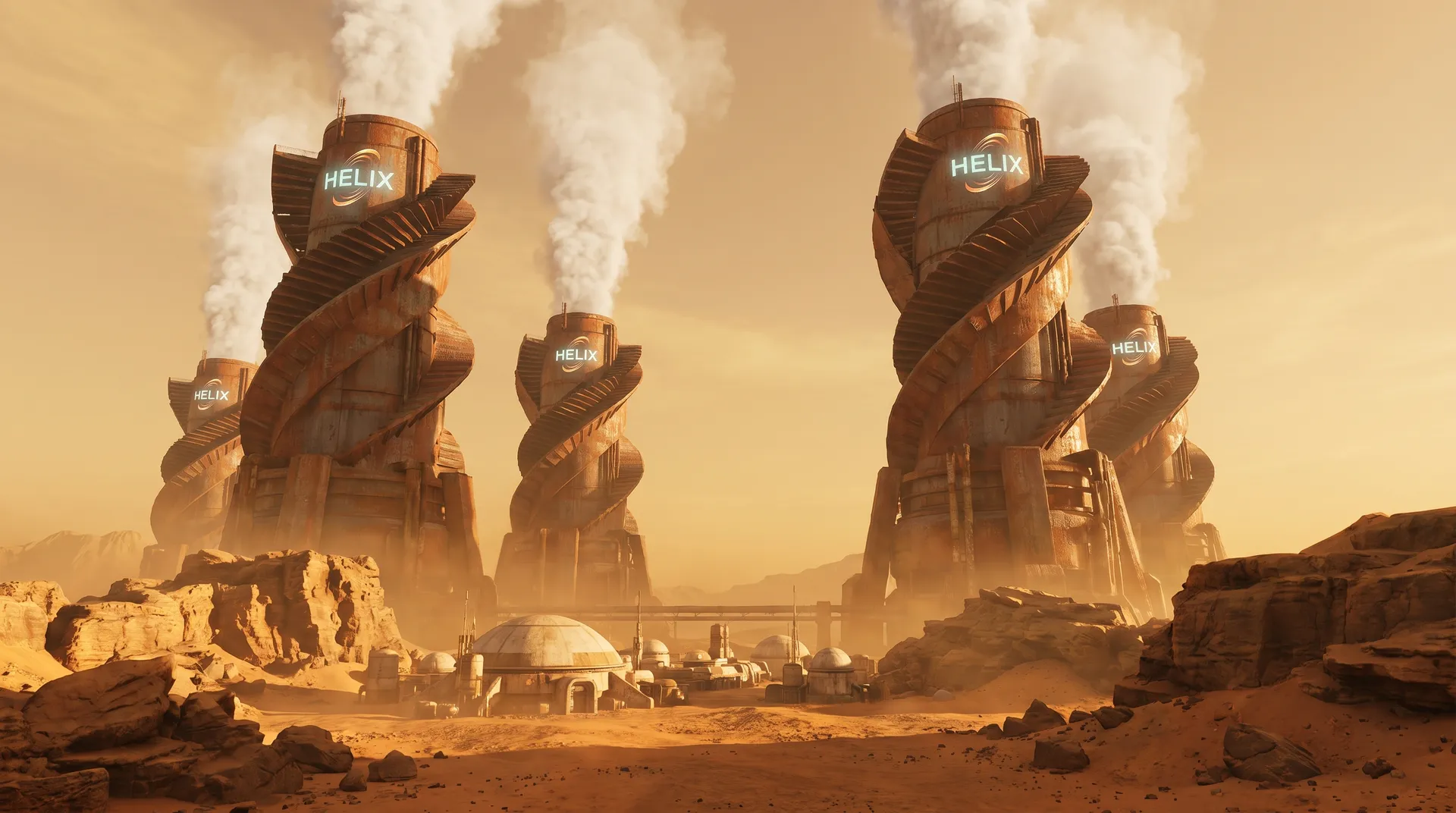
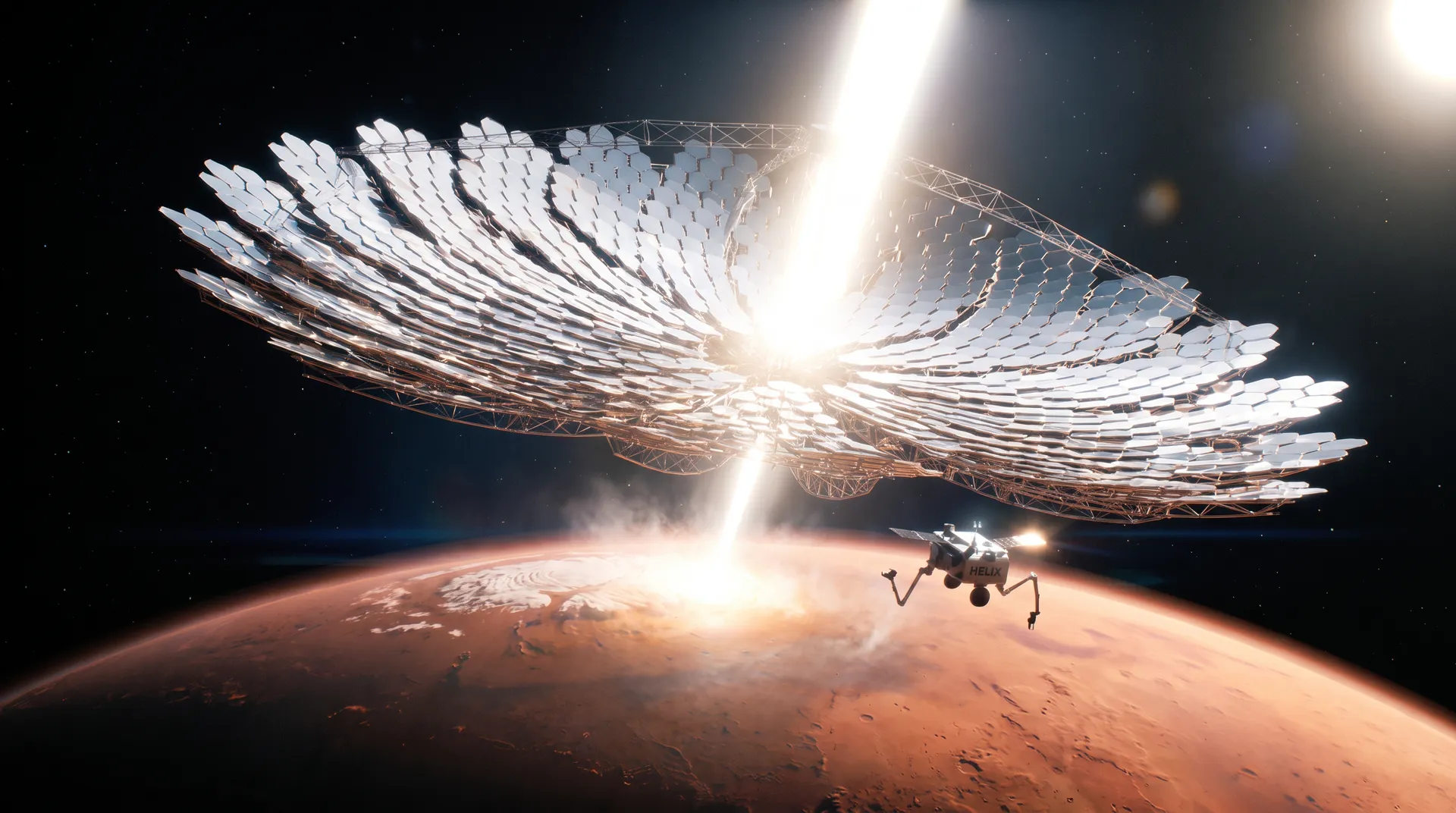
Red Horizon's Mars starts with a butterscotch sky, two small moons at dusk, and Earth as a tiny blue star at night. A hundred years after the landing, the HELIX Terraforming Directorate sets out to change that. Vast solar mirror arrays unfurl in orbit. Giant heating towers ring the north polar cap. Atmospheric processors vent tall white plumes into the sky. Dark green lichen is seeded on red stone and begins to creep. On ignition day Mira Okafor presses the control: the mirrors focus sunlight on the pole, the ice cap steams, the sky darkens, clouds form over the city for the first time, lightning flickers inside them, and the first rain falls on Mars. From orbit at the end of Track 9 the planet shows its first white cloud bands and a thin blue haze at its edge.
By Track 10, many generations later, the work is done: blue sky, seas, forests, white cities, kites over a seaside promenade, and nobody wearing a helmet.
- Seen in: Tracks 9, 10.
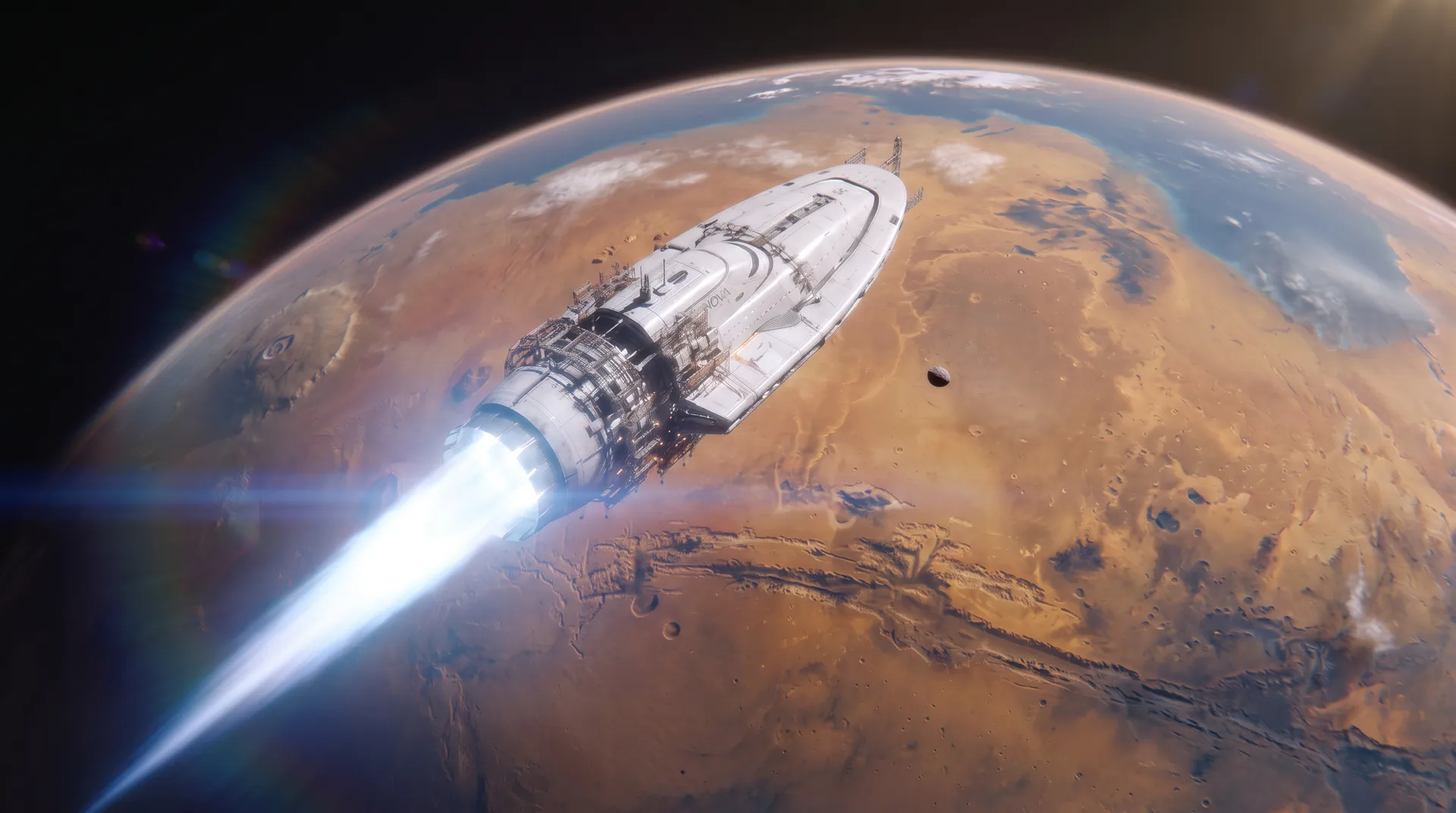
The starship NOVA
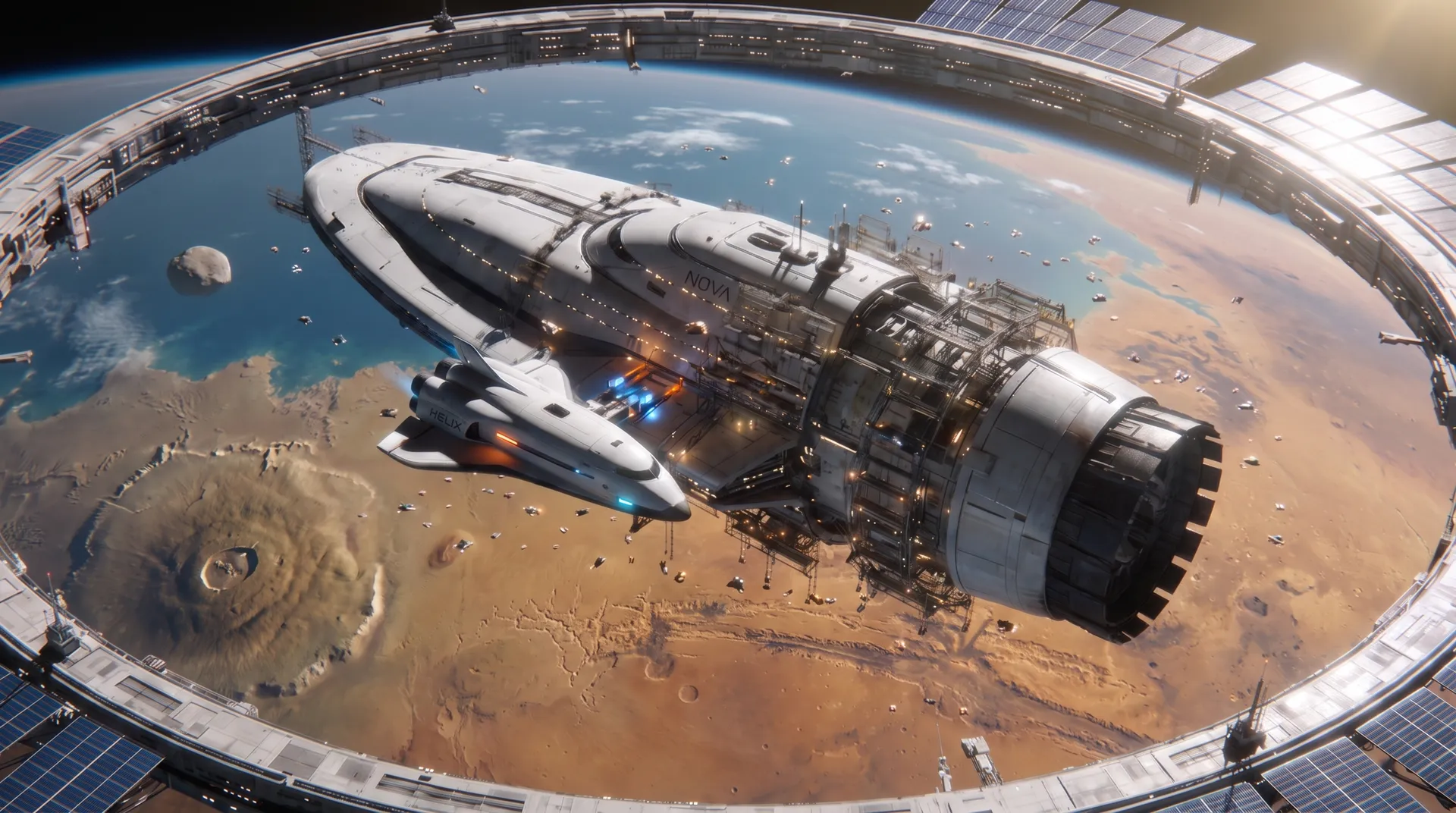
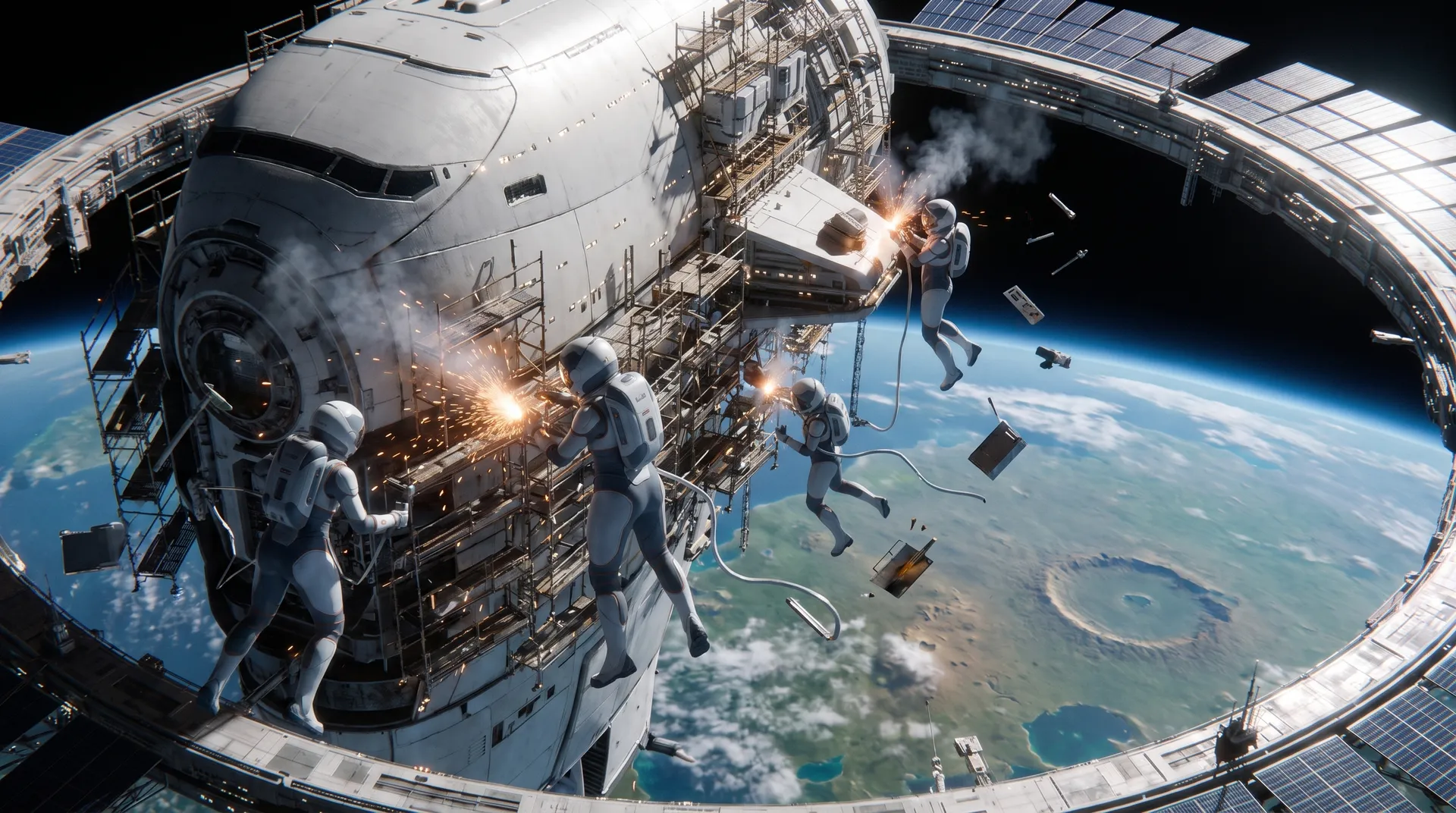
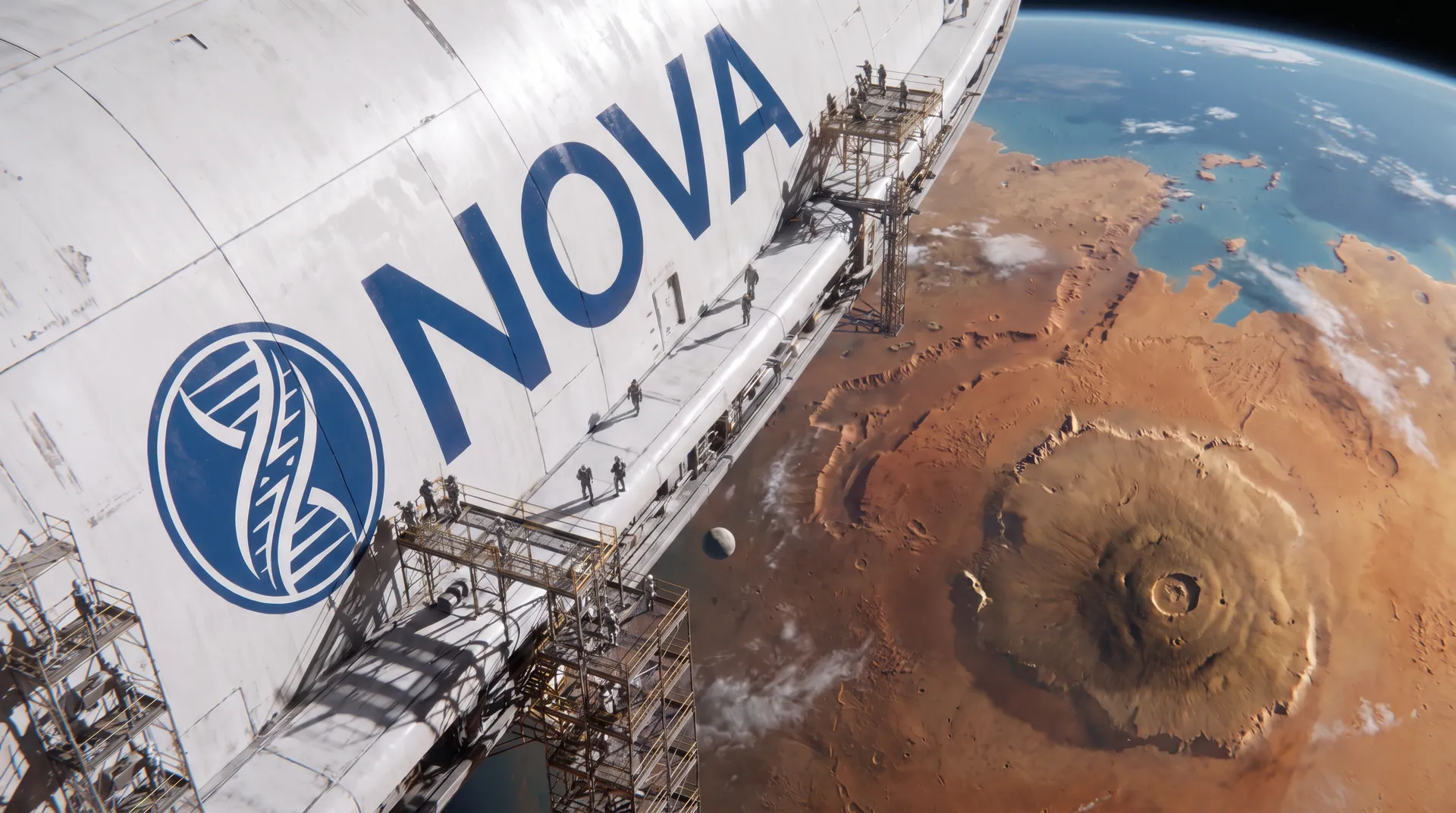
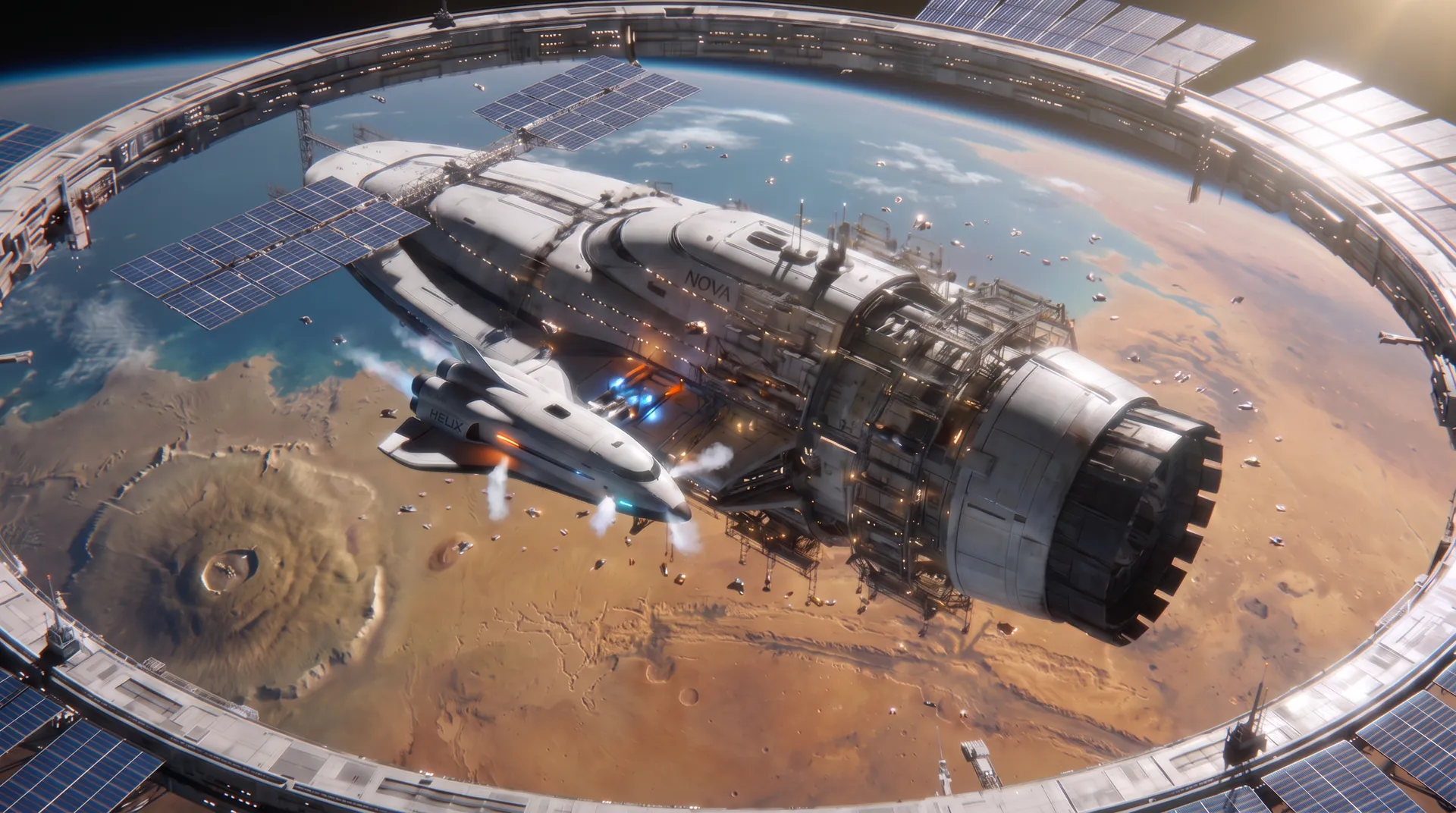
The last machine in the album is the largest. A colossal starship is built in a shipyard ring above a blue-green Mars, workers in sealed suits welding its hull plates with sparks drifting into the dark, and the name painted on its side in giant letters is NOVA, after the first child born on the planet. It carries a crew of eight, a vault of seeds descended from Yuki Tanaka's first tomatoes, and, beside the captain's console, a three-hundred-year-old photograph and a toy rocket. Its destination is a golden star with a small blue world beside it, found through the telescope at the Olympus Mons observatory.
Captain Kaia Okafor takes it out past Jupiter's storms and across the rings of Saturn. On the hills of Mars, crowds watch it cross the night sky as a new star. It leaves the solar system with the Sun shrinking behind it and becomes a point of light among the others.
- Seen in: Track 10.